Gold has been part of electronics for decades because it conducts well and refuses to corrode. On a printed circuit board it shows up as a thin plating on contacts, never as a solid chunk of metal. That distinction matters. People looking up gold content usually want one of two things: a clear picture of what a finish does to reliability and cost, or a sense of what a pile of scrap is worth. Where your interest is the recovery side, a dedicated guide on extract gold from PCB walks through the methods. This article sticks to the numbers and what drives them.
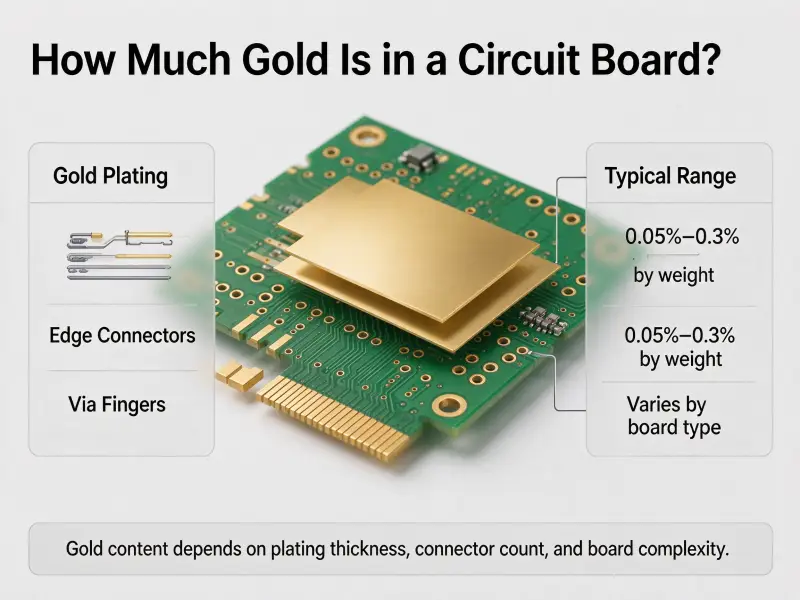
A single circuit board holds only a trace of gold, typically 0.03 to 0.3 grams depending on the device type, board age and surface finish. The metal sits on edge connectors, plated through-holes and chip bonding pads rather than spread across the board. On its own it is worth very little. Value shows up when large volumes of boards are processed together, which is why gold recovery is an industrial job rather than a one-board exercise.
The sections below break down the amounts, the finishes that change them, and how to judge a board.
Here is a quick snapshot of typical gold content by board type (ranges published in PCB industry guides, checked 24 November 2026):
| Board type | Typical gold per board |
|---|---|
| Smartphone logic board | 0.03–0.06 g |
| Laptop motherboard | 0.2–0.5 g |
| Desktop motherboard | 0.4–0.7 g |
| Server motherboard | 1–2 g |
| High-end telecom board | 2–5 g |
Why gold is used in circuit boards
Gold earns its place on a circuit board because it carries signal cleanly, does not oxidise, and survives repeated mating cycles. Those three properties keep contacts working for the life of the product, so the metal turns up in connectors and other high-wear spots even though it costs far more than copper.
Copper does the heavy lifting on a board. It forms the traces and planes that move current between parts. Gold is saved for the places where copper would let you down: it conducts almost as well, it never tarnishes, and it stays ductile under rubbing. A connector that gets plugged and unplugged dozens of times would lose a tin or copper surface to oxidation. A gold-plated one holds a stable contact resistance through the same treatment.
Reliability is what tips the decision in aerospace, medical and telecom hardware, where a single failing contact can mean a costly field return. That is why those categories carry more gold per board than consumer gadgets. The catch is price, so designers place gold only where the performance is actually needed. Elsewhere, cheaper finishes do the job.
Where gold sits on a board
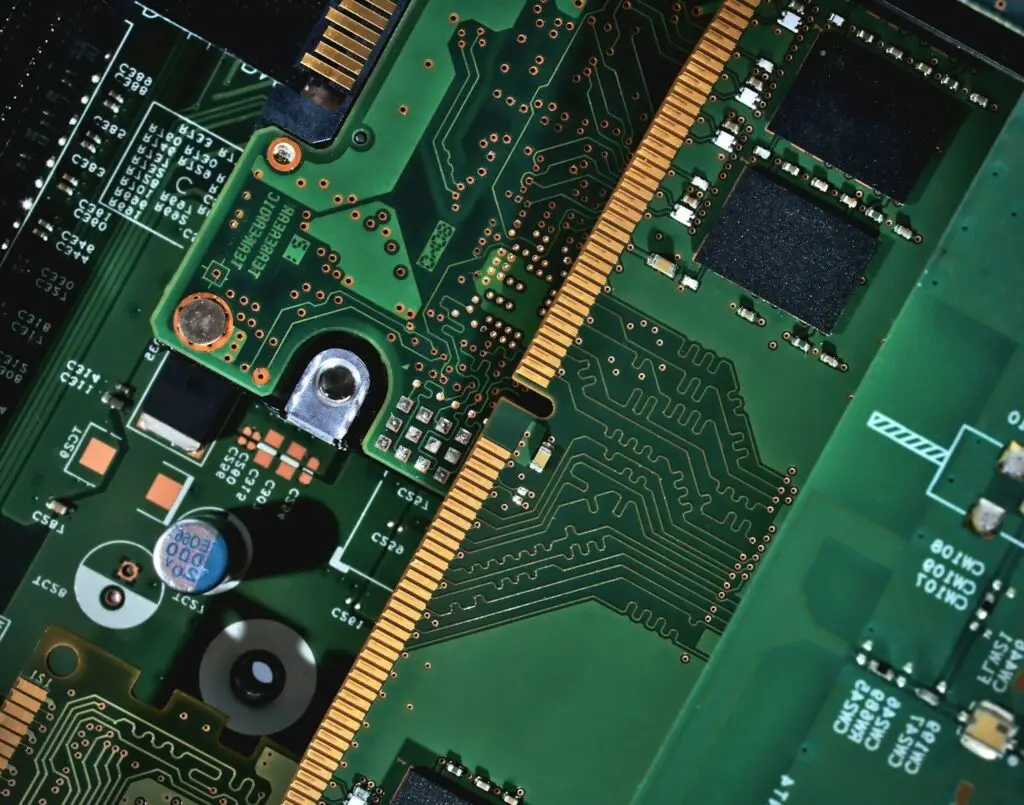
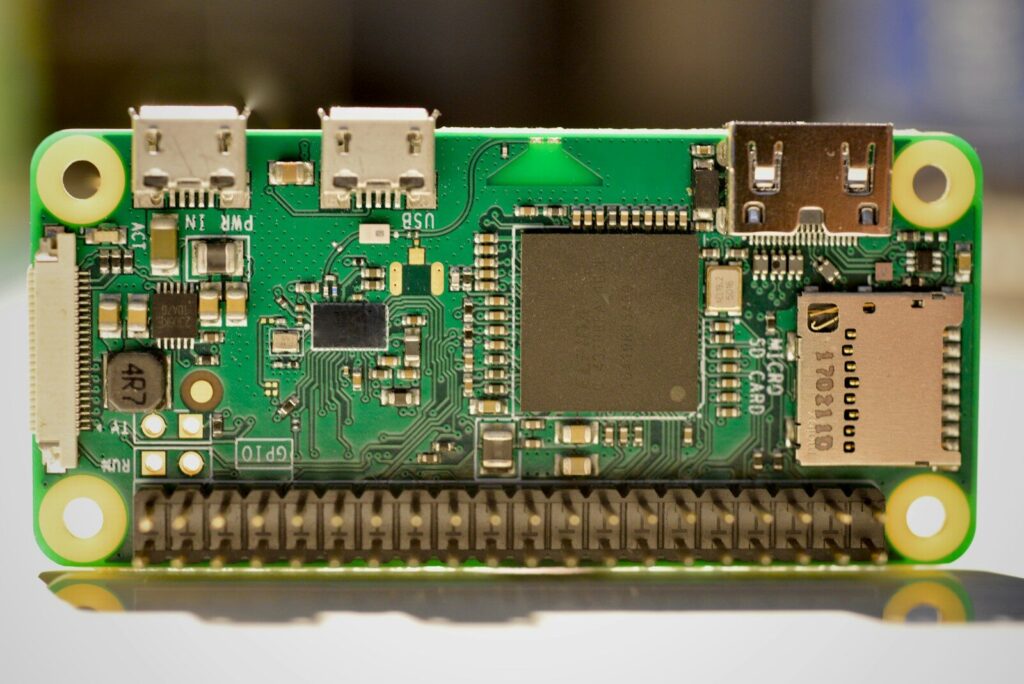
Gold concentrates in a handful of locations: edge connector fingers, plated through-hole walls, switch and relay contacts, and the bonding pads inside integrated circuits. These are the high-wear or high-precision interfaces. The substrate, solder mask and most traces hold no gold at all. Once you understand that distribution, the low per-board weight makes sense, and so does the way recyclers go straight for connectors and chips when they process a batch.
How much gold is in a circuit board
Most boards hold well under a gram of gold. Consumer boards sit at the low end of the range, while server, telecom and older industrial boards can carry several grams each. In bulk, one tonne of circuit board scrap is often cited at roughly 500 to 700 grams of gold, though the figure swings widely with the mix of boards (ranges published in PCB industry guides, checked 24 November 2026).
Three things set the amount: the kind of board, how densely it is populated, and how thick the gold plating is. A modern phone uses very little per unit because the board is small and makers have trimmed every layer. A server board is bigger, carries more connectors, and is built for a long service life, so it holds more.
Age counts as well. Older computers and industrial gear were built when gold was cheaper and parts were larger, so manufacturers used thicker plating. Such a board often out-yields a new one in the same class. That is one reason scrap buyers sort material by generation before they quote a price.
For a rough estimate, start with the device category, then adjust for age and how many connectors you can see. Treat every number as a typical range, not a promise about the specific board in your hand. Two boards that look alike can differ once you account for the finish underneath.
Gold finishes and what they mean for content
The surface finish decides how much gold a board carries. ENIG, hard gold and gold flash use very different thicknesses, so two boards of the same size can hold quite different amounts. Picking a finish is a reliability and cost call first, and a gold-content question second.
Gold goes on as a thin layer over another metal, nearly always nickel or copper. The plating method and its thickness set both the performance and the price. These are the common finishes and their typical gold thicknesses (ranges published in PCB industry guides, checked 24 November 2026):
| Finish | Typical gold thickness | Where it is used |
|---|---|---|
| Gold flash | 0.025–0.1 µm | Low-cost boards, short service life |
| ENIG (electroless nickel immersion gold) | 0.05–0.15 µm | SMT pads, general-purpose boards |
| Hard gold (electroplated) | 0.5–5 µm | Edge connectors, high-wear contacts |
ENIG is the finish you will meet most often. It lays a thin gold layer over nickel, which resists corrosion and gives a flat surface for fine-pitch parts. It uses far less gold than hard plating, and that is why it took over from thicker finishes in most consumer products.
Hard gold belongs where a surface takes physical wear. Edge connectors and gold fingers are plated thick enough to survive repeated insertion. That toughness comes at a price, and it is the main reason a telecom or industrial board holds more gold than a phone board. To see how these layers fit into the full build, look at what PCBs are made of, which covers the substrate, copper and laminate choices sitting under the finish.
How to tell if a circuit board has gold in it
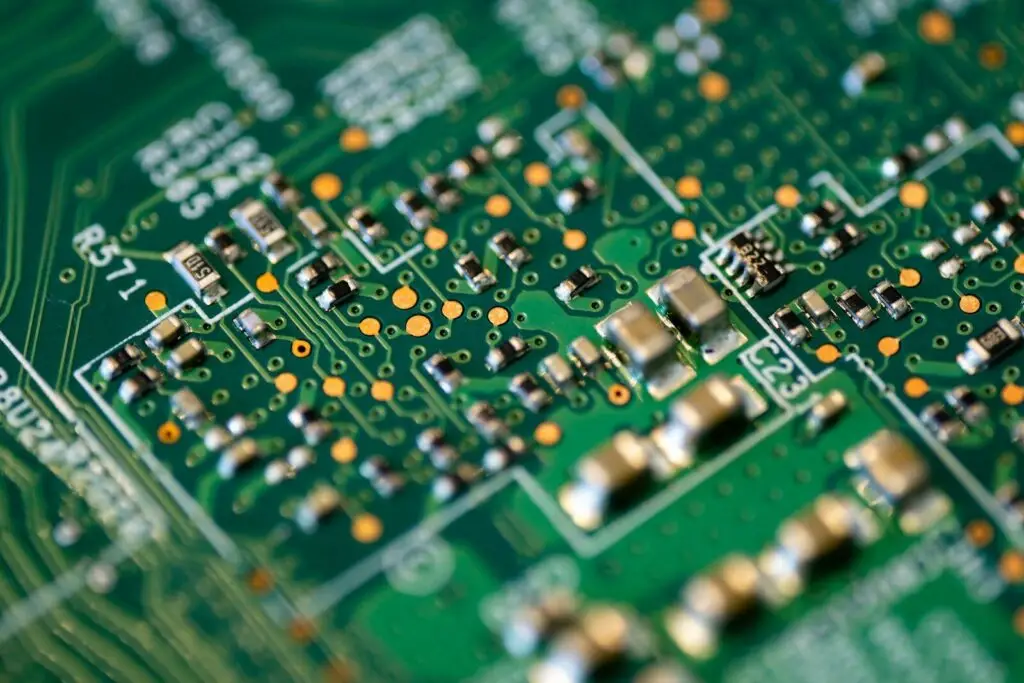
Start with the contacts. Gold shows as a distinct yellow layer on edge fingers, connector pads and some chip leads. If a board has those features, it almost certainly carries gold somewhere. A handheld XRF analyser gives a firm reading when the finish is unclear or the plating is too thin to see.
Visual inspection catches most cases. Edge connectors on memory cards and older expansion boards show a bright, even gold colour. A board with no visible contacts can still hold gold inside its chips, where bonding wires and pads are plated. That metal is far too thin to pick out by eye once it is sealed inside a component.
Board age and class offer another clue. Industrial, military and telecom boards from earlier decades usually carry thicker plating. Modern consumer boards use thin ENIG or gold flash that can be hard to tell apart from a bare copper or tin finish by looking alone.
For a dependable answer, use an XRF scanner. It reads the elements on a surface in seconds and does not damage the board. Recyclers and scrap buyers lean on it because a visual guess can misprice a whole batch. If the board is headed into production rather than scrap, check the fabrication notes instead. The drawing will name ENIG, hard gold or an alternative, and that is better evidence than colour.
Is it worth extracting gold from circuit boards
For one board, no. The gold in a single consumer board is worth far less than the chemicals, labour and equipment needed to get it out. Recovery starts to make sense when boards are collected in bulk, sorted by grade, and run through systems built to handle the volume safely and within the rules.
Four things drive the economics. First is gold content, which varies by board type and age as we have seen. Second is processing cost, including mechanical breakdown, chemicals and refining. Third is regulation, since plenty of chemical routes are restricted and need licensed handling. Fourth is the gold price, which moves with the market.
Because that price moves, the value of a batch is better worked out as a formula than a fixed figure: the gold in the batch multiplied by the market price per gram on the day of sale. That result still has to absorb recovery and refining costs. Use a current quote, never an old worked example, and apply it to weighed, graded material rather than a vague estimate.
Volume changes the picture. A plant processing tonnes of boards can spread fixed costs across the batch and pull out silver, palladium and copper at the same time. Someone working one board at a time cannot. Grade matters too, which is why mixed scrap gets sorted before anyone quotes.
How much is a gold circuit board worth
Value is a calculation, not a set number. Weigh the graded material, estimate its gold content from the board type, then multiply by the market price per gram on the day you sell. Since gold prices shift, older examples can lead you astray; always apply a live quote. Keep in mind that the figure before refining costs is not what a seller pockets. Buyers deduct processing and refining, and they price by grade, so the same board can draw different offers depending on how it was sorted and how the content was verified.
Recovery methods and environmental impact
Gold recovery begins by stripping components and breaking the board into smaller pieces, then separating out the metals. Chemical, electrochemical and thermal routes each isolate gold in a different way, and each brings cost and safety duties. The method follows the scale, the board grade and the local rules.
Mechanical separation comes first. Boards are cleared of reusable parts, shredded and milled so the metal-bearing fractions can be concentrated. On its own this step yields no pure gold, but it raises the grade of what moves downstream.
Chemical recovery dissolves gold out of the concentrated material and then pulls it back from solution. Electrochemical methods use a current to plate gold onto a cathode. Fire assay or smelting melts the material and separates metals by their differing properties. Every route needs controlled handling of fumes, liquids and leftovers, which is why informal processing is both inefficient and risky.
Environmental rules belong in the economics, not tacked on at the end. Regulators treat electronics recycling as a controlled activity because of those hazards. The US Environmental Protection Agency’s guidance on electronics and sustainable materials management explains why safe handling matters and how recovering material cuts the need for raw extraction.
Done properly, recovery keeps boards out of landfill and lowers demand for mined gold. It also saves silver, palladium and copper that would otherwise be lost. The environmental case is strongest when licensed operators process large volumes with the right kit, rather than breaking boards down by hand.
What this means for PCB buyers and designers
For buyers, the useful point is that gold content is a result of design choices, not a feature to chase. Specify the finish the application needs, accept the cost that comes with it, and treat recovery as a separate matter handled at end of life.
When you order a board, let the operating conditions pick the finish. ENIG suits fine-pitch surface mount work and general reliability. Hard gold makes sense on connectors that see repeated mating. Gold flash can serve low-cost, short-life products. Calling for a thicker finish than the design needs adds cost without adding anything in use. As you weigh those choices, the PCB assembly design guide covers how finish selection interacts with assembly and solderability.
Recyclers should do the mirror image: price by grade and confirm content with a scanner rather than a glance. Both sides gain from the same habit, which is knowing what the board is made of and why the gold is there, then deciding on evidence.
FAQ
Does ENIG contain more gold than hard gold
Not usually. ENIG deposits a thin gold layer over nickel, while hard gold is electroplated much thicker to resist wear. The practical upshot is that a hard-gold edge connector carries more gold than an ENIG pad of the same area, but far fewer boards use it. If you are picking a finish, think of the gold amount as a by-product of the durability requirement, not a target in itself.
Why do older circuit boards contain more gold
Older boards were made when gold cost less and parts were bulkier, so makers applied thicker plating and used more gold-covered components. Modern designs rely on thin ENIG or gold flash layers to hold down cost. That is why a vintage board often yields more than a new one of the same size, and why scrap buyers pay attention to the date and class of the equipment.
Can I specify a gold finish on a custom PCB order
Yes. Most fabricators offer ENIG, hard gold and gold flash as surface finish options. The right pick depends on your assembly method, how much the connector is handled, and your budget. Ask for the finish to be written into the fabrication notes so the plated thickness is controlled and can be checked when the boards arrive.