In today’s digital world, almost every electronic device relies on a Printed Circuit Board (PCB). From smartphones and laptops to medical equipment, industrial automation systems, electric vehicles, and aerospace technologies, the Printed Circuit Board (PCB) serves as the backbone of modern electronics. Without a Printed Circuit Board (PCB), electronic devices would require complex wiring systems that are difficult to manufacture, maintain, and scale.
As electronic products continue to become smaller, faster, and more intelligent, the importance of advanced Printed Circuit Board (PCB) technologies has grown significantly. Modern innovations such as AI computing, 5G communications, electric vehicles, robotics, and IoT devices demand increasingly sophisticated Printed Circuit Board (PCB) solutions, including HDI PCBs, High Speed PCB, High Frequency PCB, and Rigid-Flexible-PCB technologies.
For businesses seeking reliable electronics manufacturing services, choosing an experienced partner such as SLPCBA can significantly improve product quality, speed-to-market, and manufacturing efficiency.

What is a Printed Circuit Board (PCB)?
A Printed Circuit Board (PCB) is a non-conductive board that mechanically supports and electrically connects various Electronic Components through conductive copper traces etched onto its surface.
The primary purpose of a Printed Circuit Board (PCB) is to provide:
- Electrical connectivity
- Mechanical support
- Signal transmission
- Power distribution
- Thermal management
A typical pcb printed circuit board consists of several layers that work together to create reliable electrical pathways between different circuit board components.
Basic Structure of a PCB
| Layer | Function |
|---|---|
| Substrate | Provides mechanical support |
| Copper Layer | Conducts electrical signals |
| Solder Mask | Protects copper traces |
| Silkscreen | Displays labels and markings |
| Surface Finish | Improves solderability |
The pcb circuit board replaces traditional wiring systems, making electronic products more compact, reliable, and cost-effective.
PCB vs PCB Assembly
Many people confuse a Printed Circuit Board (PCB) with a PCB Assembly.
The difference is simple:
| PCB | PCBA |
|---|---|
| Bare board only | Completed board with components |
| No components mounted | Components installed and soldered |
| Electrical pathways only | Functional electronic system |
A PCB Assembly process transforms a bare pcb board into a working electronic product.
Other common industry terms include:
- printed circuit assembly
- circuit card assembly
- printed circuit board assembly
- pcb board assembly
- pc board assembly
- assembled circuit board
- pcb printed circuit board assembly
- printed circuit board assy
- printed circuit board and assembly
These terms generally refer to completed electronic assemblies ready for testing and integration.
Key Components Found on a PCB
A Printed Circuit Board (PCB) contains numerous Electronic Components that perform specific electrical functions.
Active Components
Active components require power to operate.
Examples include:
- Transistors
- Integrated Circuits (ICs)
- Microprocessors
- Amplifiers
- Sensors
- Oscillators
Passive Components
Passive components store or regulate energy.
Examples include:
- Resistors
- Capacitors
- Inductors
- Transformers
- Relays
- Fuses
Together, these circuit board components form the foundation of modern electronic systems.
Types of Printed Circuit Boards
Different applications require different types of Printed Circuit Board (PCB) technologies.
Rigid PCB
A Rigid PCB is the most commonly used PCB type.
Characteristics:
- Strong mechanical structure
- Cost-effective manufacturing
- Suitable for mass production
- Excellent reliability
Applications:
- Computers
- Industrial equipment
- Consumer electronics
- Automotive systems
Most traditional circuit boards fall into this category.
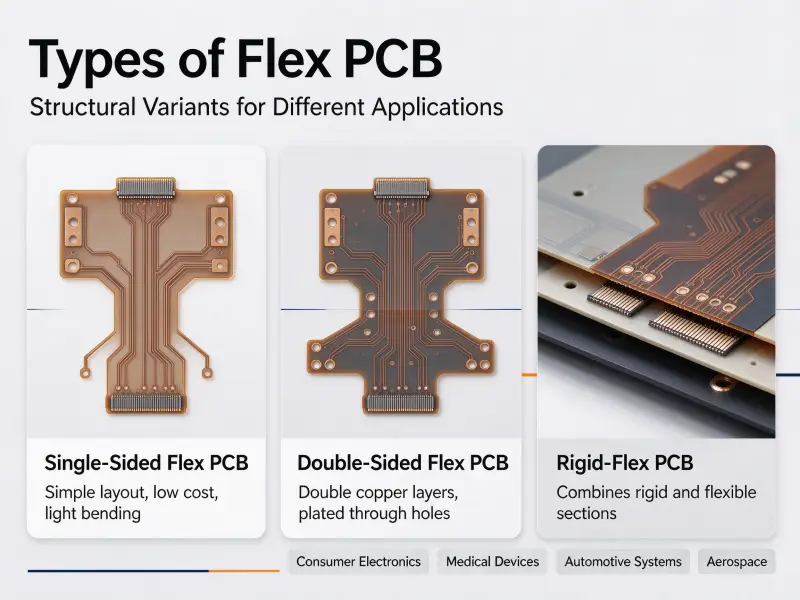
Flexible PCB (Flex-PCB)
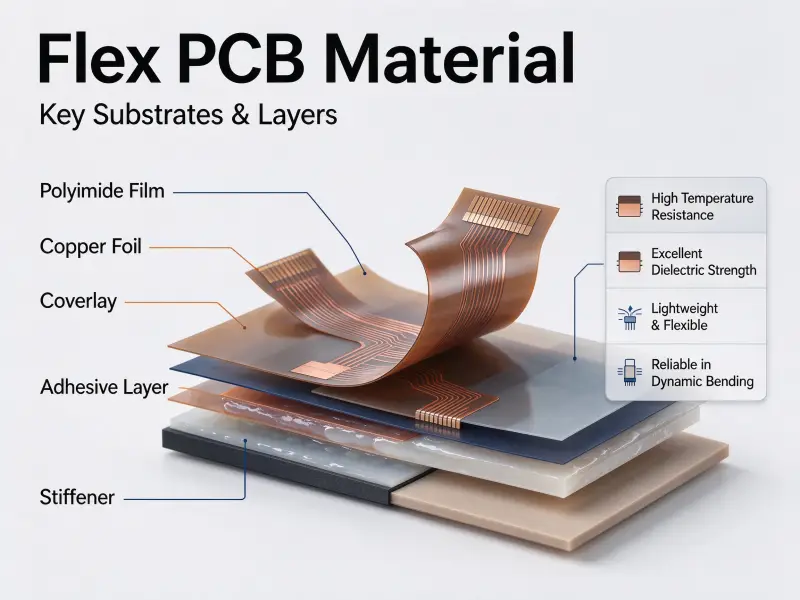
A Flex-PCB uses flexible polyimide materials instead of rigid fiberglass.
Benefits include:
- Lightweight construction
- Bendability
- Reduced assembly space
- Improved vibration resistance
Common applications:
- Smartphones
- Cameras
- Wearables
- Medical devices
Alternative industry names include:
- flexible pcb
- flexible printed circuit
- flexible circuit board
- flexible printed circuit board
- flexible pcb board
- flex printed
- flex circuit board
Rigid-Flexible-PCB
A Rigid-Flexible-PCB combines rigid and flexible sections into a single structure.
Advantages:
- Reduced connectors
- Increased reliability
- Enhanced space utilization
- Better durability
Applications:
- Aerospace
- Military systems
- Medical implants
- High-end industrial controls
As devices continue to shrink, demand for Rigid-Flexible-PCB solutions continues to rise.
High Frequency PCB
A High Frequency PCB is specifically designed for RF and microwave signal transmission.
Applications include:
- 5G networks
- Satellite communications
- Radar systems
- Wireless infrastructure
Materials often include:
- Rogers laminates
- PTFE
- Advanced ceramic composites
High Speed PCB
A High Speed PCB is engineered for high-speed digital signal transmission.
Applications:
- Servers
- Data centers
- AI processors
- Networking equipment
Challenges include:
- Signal integrity
- Impedance control
- Crosstalk reduction
- Thermal management
HDI PCBs
HDI PCBs (High Density Interconnect PCBs) offer increased routing density and miniaturization.
Features:
- Microvias
- Fine traces
- Higher component density
- Reduced board size
Industries using HDI PCBs include:
- Smartphones
- Medical electronics
- Aerospace
- Consumer electronics
Metal Core PCB
A Metal Core PCB uses aluminum or copper substrates to improve heat dissipation.
Benefits:
- Superior thermal conductivity
- Improved LED performance
- Longer product lifespan
Applications:
- LED lighting
- Power electronics
- Automotive electronics
Ceramic PCB
A Ceramic PCB utilizes ceramic materials such as alumina or aluminum nitride.
Advantages:
- Excellent heat resistance
- High dielectric strength
- Superior reliability
Applications:
- Aerospace electronics
- Power modules
- Semiconductor packaging

PCB Materials and Their Importance
Material selection directly impacts the performance of a Printed Circuit Board (PCB).
Common PCB Materials
| Material | Characteristics |
|---|---|
| FR4 | Most common, affordable |
| Polyimide | Flexible applications |
| Aluminum | Thermal management |
| Copper Core | High heat transfer |
| Ceramic | Extreme environments |
When selecting materials for a pcb printed circuit, engineers consider:
- Thermal expansion
- Signal performance
- Mechanical strength
- Cost
- Environmental requirements
How PCB Designing Works
Modern pcb designing relies on advanced ECAD software tools.
The process generally includes:
1. Schematic Design
Engineers create circuit diagrams showing electrical connections.
2. Layout Design
Components are placed on the electronic circuit board.
3. Routing
Copper traces are added to create a complete pcb circuit.
4. Simulation
Electrical, thermal, and mechanical performance is analyzed.
5. Design Validation
Engineers verify manufacturability and functionality.
Effective pcb designing significantly reduces development costs and production risks.
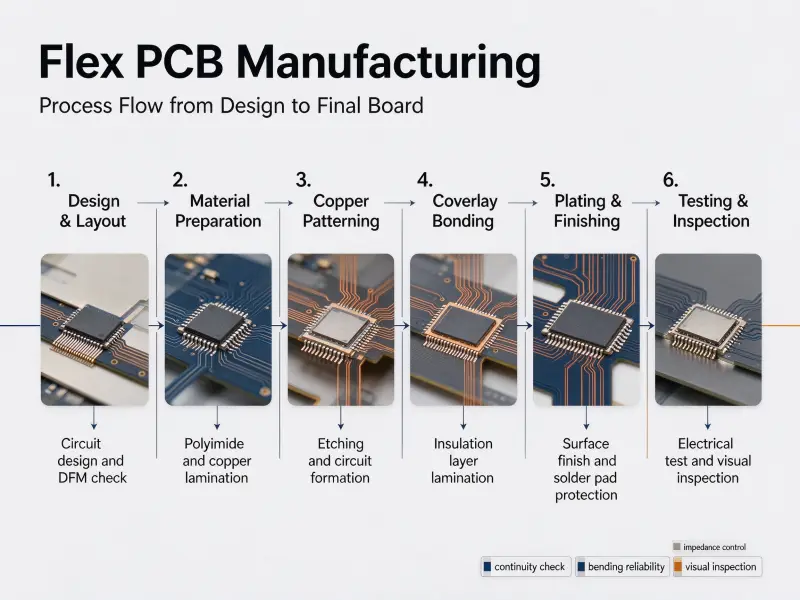
PCB Manufacturing Process
Modern pcb manufacturing involves multiple precision-controlled stages.
Step 1: Design Transfer
The design is transferred onto copper-clad laminates.
Step 2: Etching
Excess copper is removed to create conductive pathways.
Step 3: Lamination
Multiple layers are bonded together.
Step 4: Drilling
Holes are created for vias and mounting.
Step 5: Plating
Copper is deposited inside drilled holes.
Step 6: Solder Mask
A protective layer is applied.
Step 7: Silkscreen Printing
Component labels and markings are added.
Step 8: Surface Finish
Final finishes improve solderability.
This process transforms raw materials into a finished pcb board fabrication ready for assembly.
PCB Assembly Process
Following fabrication, the board enters the pcb assembly stage.
Surface Mount Technology (SMT)
SMT places miniature components directly onto board surfaces.
Benefits:
- High production speed
- Compact designs
- Automated manufacturing
Through-Hole Assembly
Components are inserted through drilled holes.
Benefits:
- Strong mechanical connections
- High durability
Mixed Technology Assembly
Many products combine SMT and through-hole technologies.
The completed pcba circuit board then undergoes testing and quality inspection.
PCB Manufacturing vs PCB Assembly
| Process | Purpose |
|---|---|
| pcb manufacturing | Produces bare board |
| pcb assembly | Installs components |
| printed circuit board production | Fabricates PCB structure |
| circuit board assembly | Creates finished product |
| pcb and assembly | Complete turnkey solution |
Many companies prefer suppliers that provide both pcb manufacturing and PCB Assembly services under one roof.
Industries Using Printed Circuit Boards
Consumer Electronics
Examples:
- Smartphones
- Tablets
- Smartwatches
- Gaming devices
Automotive
Applications include:
- ADAS systems
- EV battery management
- Navigation systems
Aerospace
PCB applications:
- Radar systems
- Flight control
- Satellite communications
Medical Equipment
Examples:
- MRI systems
- Patient monitoring
- Surgical robotics
Industrial Automation
Applications:
- PLC controllers
- Robotics
- Sensors
- Motion control systems
Energy Sector
PCBs are essential in:
- Solar inverters
- Wind turbines
- Smart grids
- Energy storage systems

Emerging Trends in Printed Circuit Board Technology
Several emerging trends are shaping the future of the Printed Circuit Board (PCB) industry.
AI Hardware Growth
Artificial intelligence requires:
- More processing power
- Higher data rates
- Better thermal management
This drives demand for:
- High Speed PCB
- HDI PCBs
- Advanced substrate materials
5G and 6G Communications
Future communication networks depend heavily on:
- High Frequency PCB
- Low-loss materials
- Precision impedance control
Electric Vehicles
EV growth increases demand for:
- Metal Core PCB
- High-power assemblies
- Automotive-grade reliability
Miniaturization
Consumer products continue shrinking.
As a result:
- Flex-PCB
- Rigid-Flexible-PCB
- HDI PCBs
are becoming increasingly important.
Choosing the Right PCB Board Manufacturer
Selecting the right pcb board manufacturer can determine the success of an electronic product.
Key factors include:
Manufacturing Capabilities
Look for support for:
- Rigid PCB
- Flex-PCB
- Rigid-Flexible-PCB
- High Frequency PCB
- High Speed PCB
- HDI PCBs
- Metal Core PCB
- Ceramic PCB
Quality Certifications
Important certifications:
- ISO 9001
- IATF 16949
- ISO 13485
- UL Certification
Engineering Support
A professional pcb board maker should offer:
- DFM review
- Material selection guidance
- Prototype support
Turnkey Services
Working with suppliers offering:
- printed circuit board assembly
- pcb board assembly
- printed circuit board and assembly
can significantly reduce lead times and supply chain complexity.
Why Global Brands Choose SLPCBA
SLPCBA is a professional printed circuit manufacturer specializing in comprehensive PCB solutions.
SLPCBA Advantages
Advanced PCB Technologies
SLPCBA supports:
- Rigid PCB
- Flexible PCB
- Rigid-Flexible-PCB
- High Frequency PCB
- High Speed PCB
- HDI PCBs
- Metal Core PCB
- Ceramic PCB
Complete Manufacturing Services
From circuit board production to PCB Assembly, SLPCBA provides complete turnkey services including:
- PCB prototyping
- pcb board fabrication
- SMT assembly
- Through-hole assembly
- Functional testing
- Box build assembly
Strict Quality Control
Every pcb board production project undergoes:
- AOI inspection
- X-ray inspection
- Flying probe testing
- Functional verification
Fast Delivery
SLPCBA helps customers accelerate product launches through efficient printed circuit board production and assembly services.
PCB Repair and Maintenance
Even the highest-quality boards may eventually require maintenance.
Common services include:
- pcb board repairing
- repairing printed circuit boards
- Component replacement
- Trace repair
- Rework services
Proper maintenance extends the lifespan of electronic products while reducing replacement costs.
Frequently Asked Questions About Printed Circuit Boards
What is the difference between PCB and PCBA?
A Printed Circuit Board (PCB) is the bare board, while a PCB Assembly includes mounted components and becomes a functional electronic device.
What are the most common PCB types?
The most common types are:
- Rigid PCB
- Flex-PCB
- Rigid-Flexible-PCB
- HDI PCBs
- Metal Core PCB
- Ceramic PCB
What industries use PCBs the most?
Major industries include:
- Consumer electronics
- Automotive
- Medical
- Aerospace
- Telecommunications
- Industrial automation
How long does PCB manufacturing take?
Depending on complexity:
| Service | Lead Time |
|---|---|
| Prototype PCB | 24-72 hours |
| Standard Production | 5-10 days |
| Complex HDI PCB | 10-20 days |
Conclusion
The Printed Circuit Board (PCB) remains one of the most important inventions in modern electronics. Every pcb circuit board, electronic circuit board, and printed wiring board plays a critical role in enabling today’s connected world. As technologies such as artificial intelligence, electric vehicles, industrial automation, and 5G communications continue advancing, demand for sophisticated Printed Circuit Board (PCB) solutions will only increase.
Whether you require a standard Rigid PCB, advanced HDI PCBs, a high-performance High Frequency PCB, or complete PCB Assembly services, partnering with an experienced manufacturer is essential for product success.
SLPCBA combines advanced pcb manufacturing, professional engineering support, strict quality control, and full turnkey printed circuit board assembly services to help customers bring innovative electronic products to market faster and more efficiently.
If you are looking for a trusted partner for pcb board fabrication, circuit board manufacturing, pcb board assembly, or complete pcb printed circuit board assembly solutions, contact SLPCBA today and discover how our expertise can support your next electronics project.