Most boards are specified on FR-4 before anyone asks what the circuit actually needs. The default is safe, widely stocked, and easy to quote, so it survives procurement review without argument. It also gets applied to products that will never see a plated through-hole, a reflow cycle above 230°C, or a signal fast enough to care about dielectric loss. On a high-volume single-sided assembly, that habit costs money on every unit, and the money adds up quietly inside the bill of materials. Understanding the PCB board materials that sit below FR-4 on the price ladder is the first step toward quoting a board that fits its job.
FR-1, a paper-phenolic laminate, is the cheapest PCB material in commercial use. It costs less than FR-4 because the core is cotton paper instead of woven fiberglass, and it can be punched instead of drilled. That price only holds under three conditions: the board is single-sided, it has no plated through-holes, and the circuit runs at low frequency in a dry environment. Break any of those three and FR-1 stops being cheap, because the failures cost more than the laminate saved.
This guide walks the ladder from paper to woven glass, then shows where the rest of a board quote actually comes from.
The substrate price ladder, from paper to woven glass
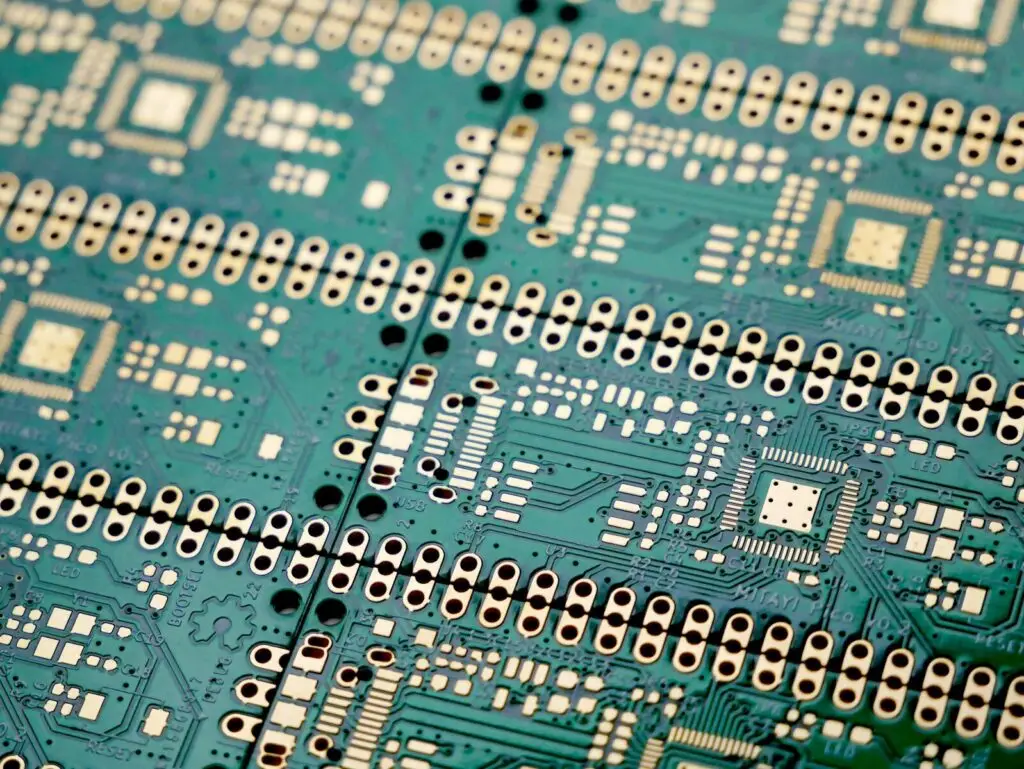
Every rigid laminate is a reinforcement plus a resin. Paper is cheaper than glass fabric, phenolic is cheaper than epoxy, and flame-retardant grades cost more than plain ones. Moving down that ladder lowers the material price and narrows what the board can survive.
The classification isn’t informal. IPC-4101, the base material specification published by IPC, assigns each laminate family its own specification sheet with minimum values for glass transition temperature, peel strength, moisture absorption, and electrical properties. A drawing that cites the standard commits the fabricator to those numbers rather than to a trade name. You can read the sheet structure in the IPC-4101 table of contents.
Paper-phenolic: FR-1 and FR-2
FR-1 and FR-2 use cellulose paper impregnated with flame-retardant phenolic resin. Neither carries a minimum Tg requirement under the standard, because neither is expected to survive lead-free reflow more than once. Their real advantage isn’t the resin at all. Paper laminates are soft enough to die-punch, so a hundred holes land in one press stroke instead of a hundred drill cycles.
The restriction is absolute: single-sided only. A paper core won’t hold copper plating inside a drilled hole, so plated through-holes and the double-sided routing that depends on them are off the table. Boards made this way turn up in remote controls, calculators, LED tube drivers, and disposable consumer goods.
There is a cheaper grade still. Non-flame-retardant paper phenolics exist and cost less again, but they fail the flammability requirements that most consumer products are certified against, which is why they barely appear in export electronics.
Composite: CEM-1 and CEM-3
CEM-1 puts a paper core between two woven glass surface layers. The glass skins add mechanical strength and give cleaner drilled holes, while the paper core keeps the price close to FR-1. It’s punchable, it takes HASL well, and it dominates single-sided LED lighting and basic power supply boards. Plated through-holes remain unreliable, so CEM-1 stays a single-sided material in practice.
CEM-3 replaces the paper core with non-woven glass fiber and keeps woven glass on the faces. That single change makes plated through-holes viable, which means CEM-3 can carry a double-sided design. Its thermal and mechanical behavior sits close to standard FR-4 at a lower laminate cost, and it’s common in home appliances and automotive body electronics.
Woven glass: standard and high-Tg FR-4
FR-4 is woven E-glass fabric in brominated epoxy. The standard grade requires a minimum Tg of 110 °C under IPC-4101; the high-Tg sheets push that to 150 °C and above, and lead-free grades reach 170 °C with inorganic fillers to control Z-axis expansion. None of it is punched. Every hole is drilled or routed, which is why FR-4 tooling costs more than paper laminate tooling at low volume.
FR-4 is the most common PCB material by a wide margin, and it isn’t the cheapest. It won that position on availability, dimensional stability, and the fact that every fabricator in the world stocks it. For anything multilayer, impedance-controlled, or destined for repeated reflow, it’s the floor rather than the ceiling. Boards built this way are what most rigid PCB manufacturing lines quote as their baseline.
| Material | Reinforcement and resin | Layers supported | Plated through-holes | Board formation | Relative board cost |
|---|---|---|---|---|---|
| FR-1 | Cotton paper, phenolic | Single-sided | No | Die-punch | Lowest |
| FR-2 | Cotton paper, phenolic | Single-sided | No | Die-punch | Lowest |
| CEM-1 | Paper core, woven glass faces, epoxy | Single-sided | Not reliable | Punch or drill | Low |
| CEM-3 | Non-woven glass core, woven glass faces, epoxy | Double-sided | Yes | Drill or route | Moderate |
| Standard FR-4 | Woven E-glass, epoxy, Tg 110°C minimum | Multilayer | Yes | Drill or route | Baseline |
| High-Tg FR-4 | Woven E-glass, modified epoxy, Tg 150°C and up | Multilayer | Yes | Drill or route | Baseline plus a premium |
What the laminate itself costs per square meter
Raw laminate is a small fraction of what you pay per board. Standard FR-4 runs about USD 8 to 15 per square meter, high-Tg material about USD 18 to 28, and PTFE-based RF laminates USD 120 to 180. Paper grades sit below standard FR-4, but the gap is measured in dollars per square meter, not in multiples.
That’s the number buyers usually expect to be decisive, and it rarely is. Fabricators publish copper-clad laminate increases of 18 to 22 percent since the fourth quarter of 2025, driven by copper and resin costs, and that pressure lands on every grade including the cheap ones. Published 2026 quotation data from PCB fabricators, checked in November 2026, puts the laminates in those ranges.
The practical consequence: switching from FR-4 to CEM-3 on a small double-sided board changes the material line in the quote and leaves the rest of it intact. Setup, drilling, imaging, testing, and freight don’t shrink because the substrate got cheaper. On a 100 by 100 mm board, the laminate difference is often a few cents. On a 500,000-unit run it becomes a real budget line, which is exactly why the material question only pays off at volume.
Where the rest of the money goes
Most of a PCB quote is process, not material. Layer count, panel fit, surface finish, tooling, and lead time move the price far more than the choice between FR-1 and FR-4 ever will.
Layer count
Each additional layer adds imaging, lamination, and registration steps, and the cost curve is steeper than most first-time buyers assume. The multipliers below are relative to a two-layer board at the same size and finish.
| Layer count | Relative cost | Typical use |
|---|---|---|
| 2 | 1.0 | Simple control boards, prototypes |
| 4 | 1.8 to 2.2 | Standard products, impedance control |
| 6 | 2.8 to 3.5 | High-speed routing, EMI control |
| 8 | 4.2 to 5.8 | Dense digital, multiple ground planes |
Panel utilization and board size
Fabricators work from panels around 18 by 24 inches. A design that yields ten boards per panel is not ten percent cheaper than one that yields eight, it’s twenty-five percent cheaper per unit, because setup and handling are spread across more saleable area. Boards under roughly 50 by 50 mm hit minimum handling charges that make the per-unit price look disconnected from the board’s actual area.
Surface finish
HASL costs about USD 0.15 to 0.25 per square decimeter. ENIG runs USD 0.45 to 0.75. That spread, multiplied across both faces and the full panel, can exceed the laminate saving from dropping a material grade. It’s also the line most likely to be quietly changed in a cheap quote, so specify the finish explicitly.
Volume and tooling
Die-punch tooling for FR-1 or CEM-1 has a fixed cost that only amortizes across large runs. At 50 pieces, paying for a punch die costs more than drilling FR-4 on a shared panel, so the cheaper material produces the more expensive board. The break-even sits in the thousands, not the hundreds.
Lead time
Standard production is priced as the baseline. Five to seven day delivery typically adds 30 to 50 percent, and 24 to 72 hour turnaround can add 100 to 200 percent, because a rush order occupies capacity that would otherwise be sold twice. A cheap board ordered in a hurry is not a cheap board.
What the cheapest material cannot do
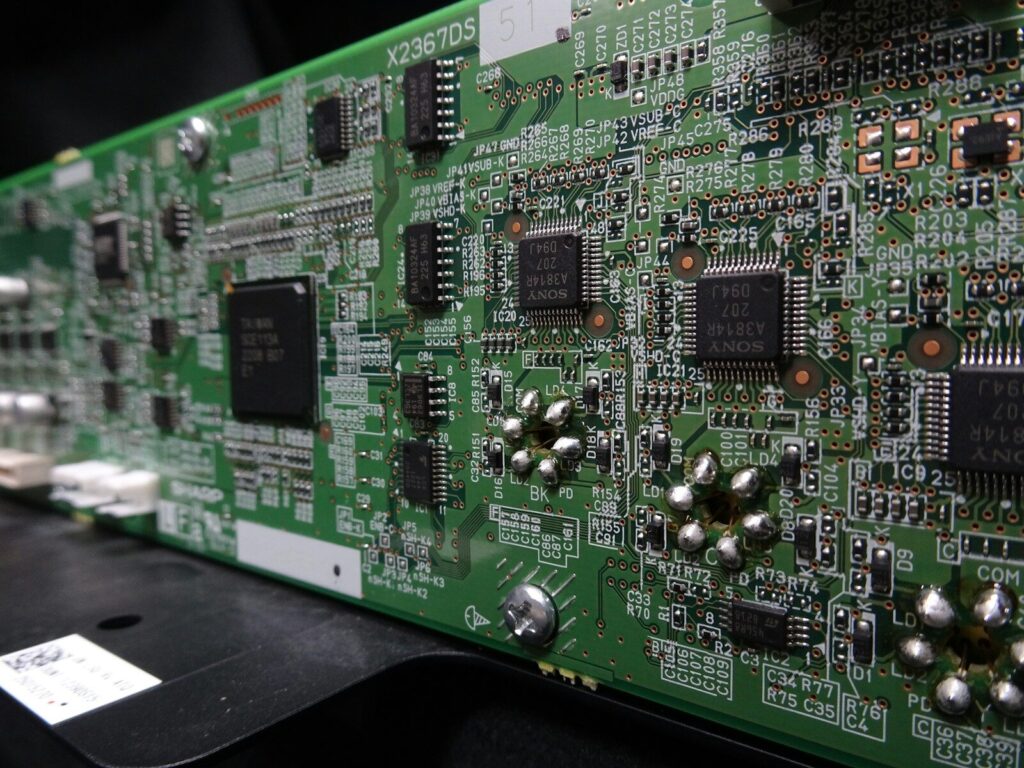
The savings reverse the moment the board leaves its intended envelope. Paper-based laminates fail in four predictable ways, and each one is a field return rather than a line item.
Thermal failure comes first. The paper core absorbs reflow heat and can delaminate or warp after repeated passes, which matters for double-sided assembly or any rework. Moisture comes second: paper laminates take on water faster than fiberglass, and in a humid, unsealed enclosure the substrate swells until traces crack or adjacent nets short.
Electrical limits come third. Dielectric constant and loss tangent on paper laminates are high and inconsistent, so impedance control is impossible and RF work is out of scope. Mechanical limits come last: a punched paper board cracks when flexed or dropped in a way that woven glass resists.
None of these are defects. They’re the terms of the deal. The mistake is buying the cheap substrate and then expecting FR-4 behavior from it.
Matching material to design and volume
Choose on application and volume, then check the price. Choosing on unit price alone is how cheap boards become expensive programs.
| Design and volume | Recommended substrate | Reason |
|---|---|---|
| Single-sided, under 1,000 units | Standard FR-4 | Punch tooling can’t amortize; shared-panel FR-4 is cheaper |
| Single-sided, over 10,000 units | FR-1 or CEM-1 | Punching and paper laminate pay off at scale |
| Double-sided, consumer grade | CEM-3 | Supports plated through-holes below FR-4 cost |
| Multilayer or impedance-controlled | Standard or high-Tg FR-4 | Predictable Dk, dimensional stability |
| LED or power board with heat load | Aluminum metal core | Not the cheapest material, but the cheapest thermal fix |
| RF above roughly 1 GHz | PTFE-based laminate | Low and stable loss; FR-4 can’t hold the tolerance |
Aluminum metal-core boards belong in this conversation because buyers often assume metal means cheap. It doesn’t. The substrate costs more than FR-4, and the value is thermal, not price. If an LED board doesn’t need heat spreading, metal core is the wrong saving to chase.
Hybrid stackups, where a cheap laminate carries the outer layers and FR-4 handles the inner ones, exist but rarely help. The mixed materials bring different coefficients of thermal expansion, and the added process control usually eats the saving. It’s worth asking about only on large, simple boards where the mechanical risk is genuinely low.
How much do PCBs usually cost?
There are two price structures, and mixing them up causes most budgeting errors. Prototype orders pay a per-unit premium for setup; volume orders pay for area and process.
A two-layer prototype order
Small runs of five to ten boards carry per-unit prices five to fifteen times higher than the volume rate for the same design, because stencil, programming, and panel setup are divided across a handful of units. Pooling services soften this by filling unused panel space with other customers’ designs, which is why a small two-layer board can quote at a few dollars per piece and still be profitable for the shop.
A four-layer board
A four-layer board typically quotes at 1.8 to 2.2 times the two-layer price at identical size and finish. The increase comes from inner-layer imaging, oxide treatment, an extra lamination cycle, and tighter layer-to-layer registration, not from the laminate. Four-layer pricing also depends heavily on whether you need controlled impedance, since that adds engineering and test time on top of the base process.
Where to find cheap boards without buying scrap
Low prices come from scale and panel sharing, not from a supplier quietly downgrading your laminate. Filter suppliers on what they can document, and the price usually takes care of itself.
Run this checklist before comparing quotes:
- Cite the IPC-4101 specification sheet on the drawing instead of writing “FR-4” and hoping, so the material grade is contractual.
- Ask for the Tg and, if the design is impedance-controlled, the Dk and Df values of the specific laminate lot.
- Confirm the layer count and whether the design needs plated through-holes before accepting a CEM-1 or FR-1 price.
- State copper weight and board thickness, since both move the price and both get assumed when they’re missing.
- Fix the surface finish in writing, because HASL substituted for ENIG is the most common silent downgrade.
- Ask how the panel is built. Suppliers who share panels can quote lower without touching material grade.
- Compare lead times on equal terms. A rush quote isn’t a price, it’s a different product.
A fabricator that can answer all seven is usually not the cheapest quote on the screen. It’s the one whose second order costs the same as the first, and that’s the number worth optimizing. Most custom PCB manufacturing programs fail on the reorder, not the pilot.

Frequently asked questions
Is CEM-3 a drop-in replacement for FR-4?
For double-sided boards at moderate temperatures, usually yes. CEM-3 accepts plated through-holes, drills cleanly, and runs through standard assembly. It is not a drop-in for multilayer stackups, thick copper, or anything requiring controlled impedance, because the non-woven glass core doesn’t hold the same dimensional tolerances.
Can you mix a cheap laminate with FR-4 in one stackup?
It’s technically possible and commercially rare. Hybrid builds put the low-cost material on outer layers and FR-4 in the core, but the two expand at different rates, and the added registration control usually costs more than the laminate saved. On large, simple boards with few vias the trade can work. Below that, keep one material per stackup.
Does a cheaper substrate change the assembly process?
Yes, and the change shows up in the reflow profile. Paper-based laminates absorb more moisture, so parts need baking before assembly, and the profile has to stay conservative to avoid delamination. Boards that will be reworked or run through two reflow passes are a poor fit for FR-1 and CEM-1 regardless of what the quote says.