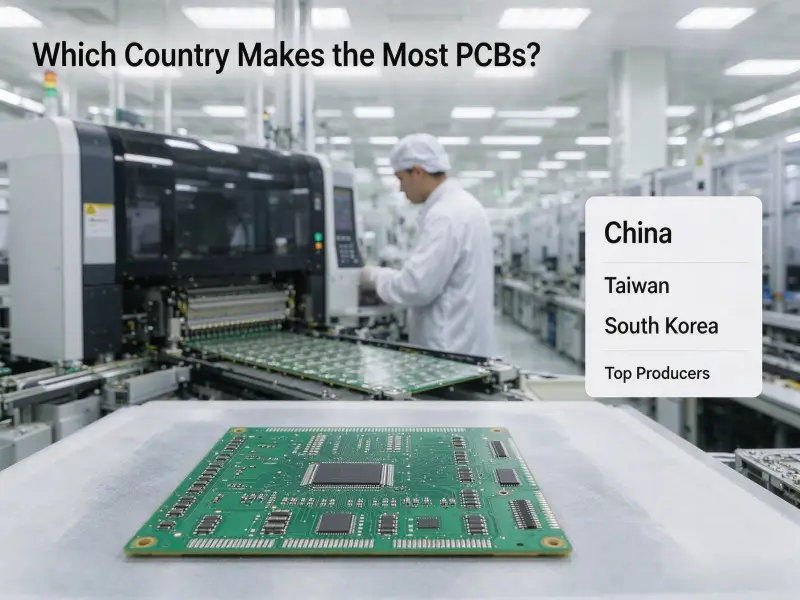
Printed circuit boards sit inside almost every electronic device, yet their production is concentrated in a handful of places. Buyers searching for the largest producer usually want one country and one clear answer. The useful answer is more detailed: it changes depending on whether you count factory output, company revenue, or the type of board being made. That distinction decides where a design gets prototyped, where it reaches volume, and how a PCB manufacturing budget holds up once freight and tariffs are added.
China makes the most PCBs by production volume, accounting for roughly 57% of global output in 2025, while the largest single manufacturer by revenue is Zhen Ding Technology of Taiwan, which Prismark ranks first for the ninth year running. Measure by company headquarters instead of factory location, and the picture shifts: mainland Chinese firms held about 37.6% of global value in 2025, and Taiwan, Japan, and South Korea each lead in different high-end categories.
The sections below separate those measures and show what each one means for sourcing decisions.
| Measure | Answer | Basis |
|---|---|---|
| Most PCBs by production location | Mainland China, about 57% of 2025 global output | Prismark figures, checked 23 November 2026 |
| Most PCBs by company origin | Mainland Chinese firms, 37.6% of 2025 global value | TPCA and ITRI observation, checked 23 November 2026 |
| Largest manufacturer by revenue | Zhen Ding Technology, USD 5.869 billion in 2025 | Prismark ranking, checked 23 November 2026 |
| Leader in advanced substrates | Taiwan, with Japan and South Korea in specific niches | Prismark regional data, checked 23 November 2026 |
The short answer: where most PCBs are made
Mainland China is the largest producer by a wide margin. In 2025 it accounted for roughly 57% of global PCB value when every factory on its soil is counted, including plants owned by Taiwanese, Japanese, and Korean groups. That share has held above 50% for two decades.
Two numbers describe the same country and often get confused. The first counts output by location. Prismark data, checked 23 November 2026, puts mainland production at about 57% of the world total in 2025, with Taiwan near 8%, Japan near 8%, and South Korea near 7%. The second counts output by the owner’s headquarters. The Taiwan Circuit Board Association and the Industrial Technology Research Institute reported in late 2025 that mainland-owned companies produced USD 34.18 billion of boards, or 37.6% of global value, up 22.3% year on year (checked 23 November 2026). The gap between 57% and 37.6% is real: many of the largest factories in Shenzhen, Kunshan, and Suzhou are funded from Taipei or Seoul.
Production location versus company headquarters
The distinction matters when you ask who actually makes a board. A contract manufacturer may quote from a Shenzhen plant, ship from a bonded warehouse, and book the revenue in Taiwan. Trade data follows the physical board; corporate rankings follow the invoice. Buyers who care about tariff classification need the first figure. Buyers assessing supplier stability usually want both. Neither number is wrong, but quoting only one gives a partial answer to the question of which country makes the most boards.
Why China leads in PCB manufacturing volume
China’s lead comes from supply chain density rather than cheap labor. The production area reached about 235 million square meters in 2025, more than half the world total, supported by roughly 1,200 volume manufacturers and thousands of material and equipment suppliers within a few hours of one another (industry figures checked 23 November 2026).
A PCB circuit needs laminate, copper foil, photoresist, solder mask, drilling, plating, and final inspection. In southern China, a fabricator short of a specific solder mask can source a replacement the same day. That cluster effect shortens validation cycles and keeps PCB electronics programs moving when a design changes late. Labor costs in the region have risen, and that is no longer the main attraction. The advantage now sits in tooling, process know-how, and the sheer number of nearby vendors. For standard multilayer boards and high-volume consumer work, few places match that setup.
The two manufacturing clusters
The Pearl River Delta, centered on Shenzhen, Dongguan, and Huizhou, handles consumer flexible circuits, high-density interconnect boards, and quick-turn prototypes. The Yangtze River Delta, around Suzhou, Kunshan, and Wuxi, focuses on high-layer server boards, IC substrates, and automotive power boards. A third group in Hubei, Jiangxi, and Sichuan absorbs capacity moving inland as coastal costs climb. Each cluster has a different cost base and a different strength, so the phrase made in China describes three fairly different sourcing environments.
Who is the world’s biggest PCB manufacturer?
Zhen Ding Technology is the world’s largest PCB manufacturer by revenue. Prismark records USD 5.869 billion in 2025 sales, the ninth consecutive year the group has held first place. Its Taiwanese rival Unimicron ranked second at USD 4.225 billion (ranking checked 23 November 2026).
The top of the table is worth reading closely, because it is dominated by companies headquartered in Taiwan and China, even though much of their output comes from mainland factories. Zhen Ding, Unimicron, Wus Group, Compeq, and Tripod together take five of the ten slots. Three mainland groups, Dongshan Precision, Shennan Circuit, and Victory Giant, make the same list. TTM Technologies is the only American representative, and Nippon Mektron is the only Japanese one.
| Rank | Company | Home region | 2025 revenue |
|---|---|---|---|
| 1 | Zhen Ding Technology | Taiwan, China | USD 5.869 billion |
| 2 | Unimicron | Taiwan, China | USD 4.225 billion |
| 3 | Dongshan Precision | Mainland China | USD 3.570 billion |
| 4 | Shennan Circuit | Mainland China | USD 3.295 billion |
| 5 | TTM Technologies | United States | USD 2.906 billion |
Source: Prismark 2025 global PCB manufacturer ranking, checked 23 November 2026.
A fragmented top tier
All ten companies together generated USD 32.391 billion, about 37.7% of global output (Prismark, checked 23 November 2026). No single supplier has pricing power across the whole market. Competition turns on specific processes instead: high-layer count, flexible circuits, IC packaging substrates. A buyer looking for the best manufacturer therefore has to define the board first. A company that leads in phone flex circuits may be a poor fit for a low-volume industrial backplane, and the reverse is equally true.
Where advanced PCBs are made
Taiwan leads in advanced substrates and high-layer server boards, Japan in high-reliability flexible circuits and specialty materials, and South Korea in memory and display substrates. These regions compete on process capability, not volume.
Ajinomoto build-up film substrates, high-density interconnect layers, and the twenty-plus-layer boards used in AI servers are concentrated in Taiwan and, to a lesser degree, Japan. Japanese fabricators kept their position in flexible printed circuits, heavy copper power boards, and low-loss materials after handing consumer volume to China and Southeast Asia. Korean suppliers built their strength around memory modules, OLED driver substrates, and rigid-flex designs tied to domestic electronics groups. None of these categories is large by area, but each carries far more value per square meter than a standard four-layer board.
When a design calls for tight impedance control or very fine trace geometry, the list of capable factories shrinks quickly. Specifying an HDI PCB stack-up, for example, narrows the field to suppliers with sequential lamination and laser drilling experience. That constraint should surface during PCB board design, before the layout is frozen, because a material available at only one plant becomes a single point of failure later.
Taiwan and the AI server board ecosystem
Taiwan’s position rests on proximity. Board makers sit close to advanced semiconductor foundries and packaging houses, so substrate designs track new silicon nodes without a long handoff. AI accelerator platforms need high-layer boards with controlled impedance and embedded components. Suppliers in Taiwan developed those processes alongside chip designers rather than after them. Japan contributes low-loss laminates and ceramics; South Korea contributes substrate work for memory and displays. A server program often combines all three.
Vietnam, Thailand, and the China Plus One shift
Southeast Asia accounted for about 12% of global PCB value in 2025, and most of that growth is assembly rather than bare-board fabrication. Vietnam and Thailand attract final SMT lines, while the raw boards and components still arrive largely from China (regional figures checked 23 November 2026).
Tariffs and supply chain diversification drive the move. Original equipment manufacturers selling into North America and Europe want a non-China assembly route, and industrial parks in Vietnam and Thailand offer cost-competitive labor with improving infrastructure. The shift has limits. Bare-board production is chemically intensive and needs wastewater treatment, laminate supply, and heavy etching equipment. Those assets take years to build. Vietnamese plants commonly receive finished boards from Guangdong or Jiangsu, populate them locally, and export the assembly. For a buyer, that means the country on the shipping label is not the country that fabricated the circuit.
The practical effect is a two-step supply chain. Prototypes and initial runs stay near the design team or in a mature cluster. Volume assembly moves to whichever country meets the destination market’s tariff rules. This works well for consumer devices and internet-of-things hardware. It works less well for products that need close engineering contact during yield ramp, where splitting fabrication and assembly across borders adds coordination cost.
What does country of origin mean for PCB price and lead time?
Factory-gate price is a poor comparison across countries. Landed cost, which adds freight, duties, and inventory carrying time, often reverses the ranking, especially for small runs where shipping dominates the unit price.
A board quoted at a lower price in Southeast Asia may cost more by the time it reaches a European or North American assembly line, because the bare board itself still travels from China. Conversely, a slightly higher quote from a vertically integrated Chinese plant can include faster material replenishment and fewer production holds. Lead time follows the same logic. A mature cluster can replace a missing component or rework a panel within a day. A newer facility may need a week for the same fix.
| Procurement scenario | Practical location | Reason |
|---|---|---|
| Prototype and design iteration | Near the engineering team, or a mature Chinese cluster | Fast feedback, broad material availability |
| High-volume consumer electronics | Mainland China, or China fabrication with Southeast Asian assembly | Cluster density, tariff planning |
| AI server and high-layer boards | Taiwan and Japan | Advanced substrate and laminate capability |
| Defense and classified work | Domestic facilities under applicable export controls | ITAR and AS9100 requirements |
Quality standards travel with the supplier rather than the flag of the factory. IPC publishes the widely used design, fabrication, and acceptability specifications, and buyers can require the same standard from a plant in any country. The real comparison is whether a supplier can hold that standard during a volume ramp, which is a question about process control and engineering support rather than geography.
How to choose a manufacturing country for your PCB project
Choose by board type, production stage, and compliance requirement, not by which country tops an output ranking. Volume leadership says little about whether a factory can support your particular design.
Start with the technical requirement. A simple two-layer controller board can be made almost anywhere, so cost and lead time decide. A board with blind vias, tight impedance, or an exotic laminate has a short supplier list, and those suppliers cluster in Taiwan, Japan, and parts of China. Set the production stage next. Prototypes benefit from proximity and quick-turn capacity; volume runs benefit from stable material contracts and tariff planning. Compliance comes last but can override everything else: classified defense work may be legally restricted to domestic, cleared facilities.
Treat fabrication and assembly as two decisions. A common pattern is bare boards from one country, components sourced from a second, and a final PCB assembly in a third. That structure can reduce duties and spread risk, but it adds inspection steps and makes root-cause analysis slower when a defect appears. For teams building their first hardware product, a single supplier handling both steps usually costs less in engineering time than the savings from splitting them. Learning PCB design with the manufacturing constraint in view, rather than after the layout is released, avoids most of the painful redesigns.
Frequently asked questions
Which country makes the most flexible PCBs?
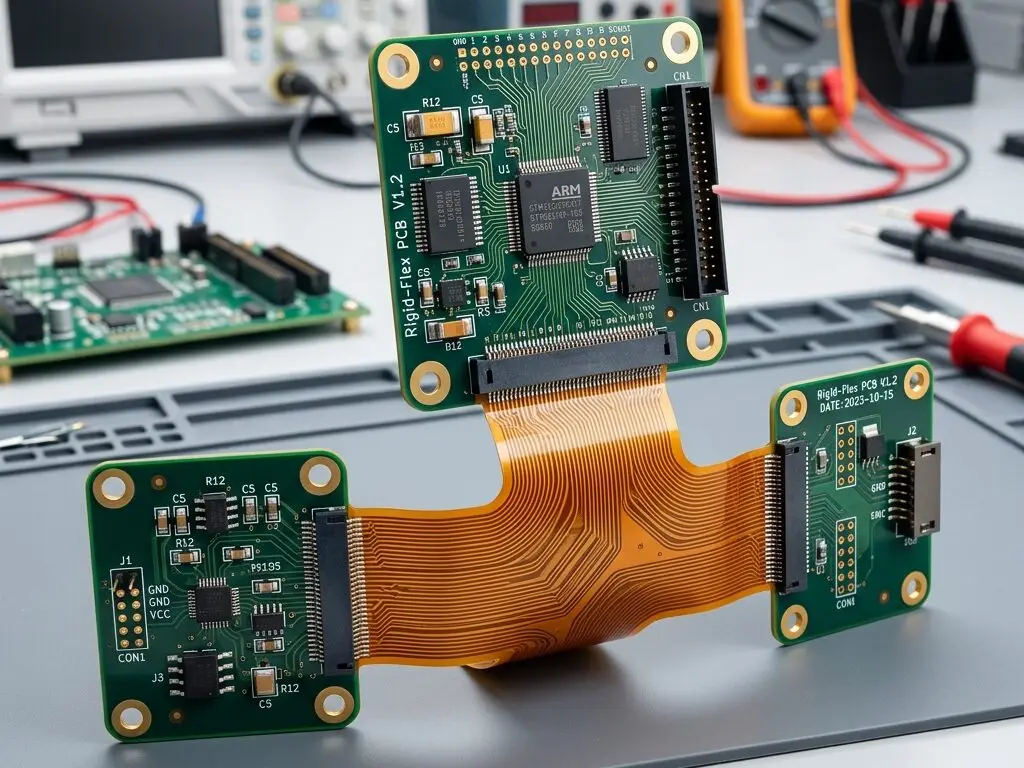
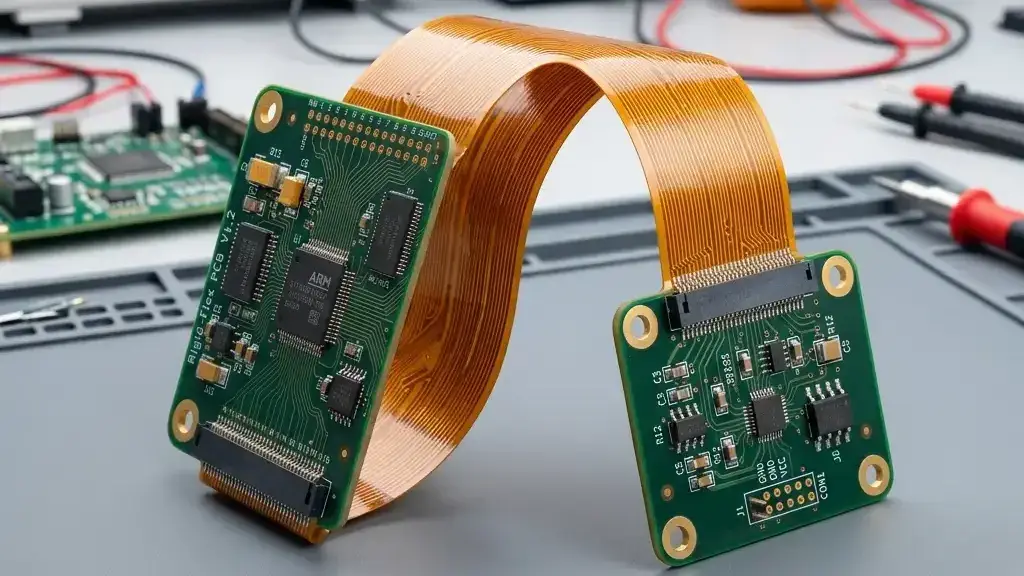
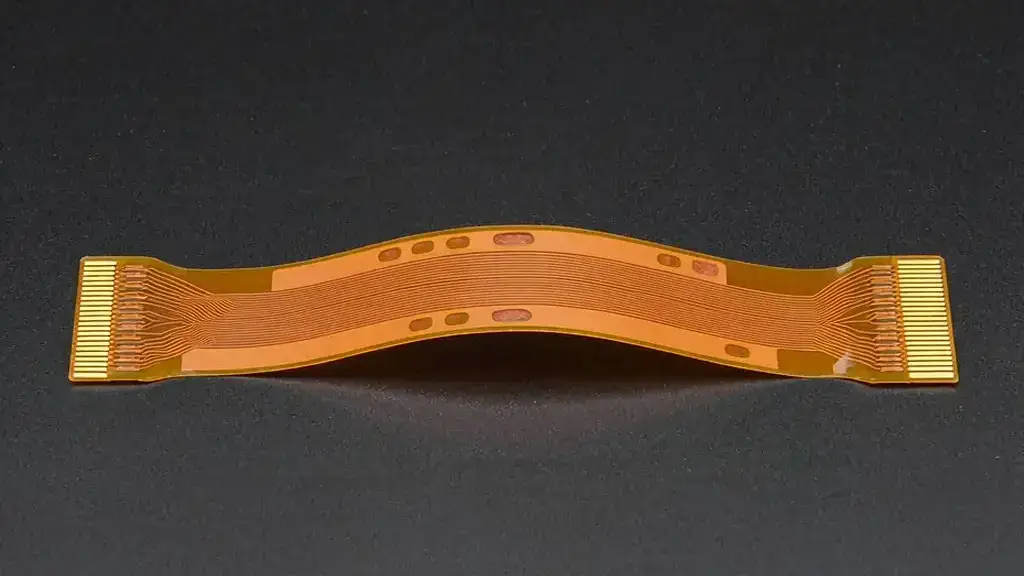
Flexible circuit output follows the same pattern as the wider market, with mainland China holding the largest share by volume and Taiwanese groups leading by revenue. Zhen Ding built its position on flexible circuits and substrate-like boards for consumer devices, and Japan’s Nippon Mektron remains a major flexible-board supplier. Automotive and wearable flex designs often source from separate clusters, so the answer depends again on the end use.
Is China still the cheapest place to make a PCB?
For standard boards at volume, it’s usually yes on factory-gate price, because material and tooling are local. That answer changes for small runs, for boards needing specialty laminates, and for shipments into markets with tariffs on Chinese electronics. Landed cost, including freight and duty, is the number to compare. A quote that looks cheap at the factory can lose its advantage after a long shipping leg.
Can I split PCB fabrication and assembly across two countries?
Yes, and many companies do. Fabrication in China with final assembly in Vietnam or Thailand is a common route for products sold in North America. The trade-off is coordination: each transfer adds inspection, paperwork, and time. Define ownership of incoming quality before you split the chain, and keep one party responsible for tracing a fault back to the bare board if something fails.