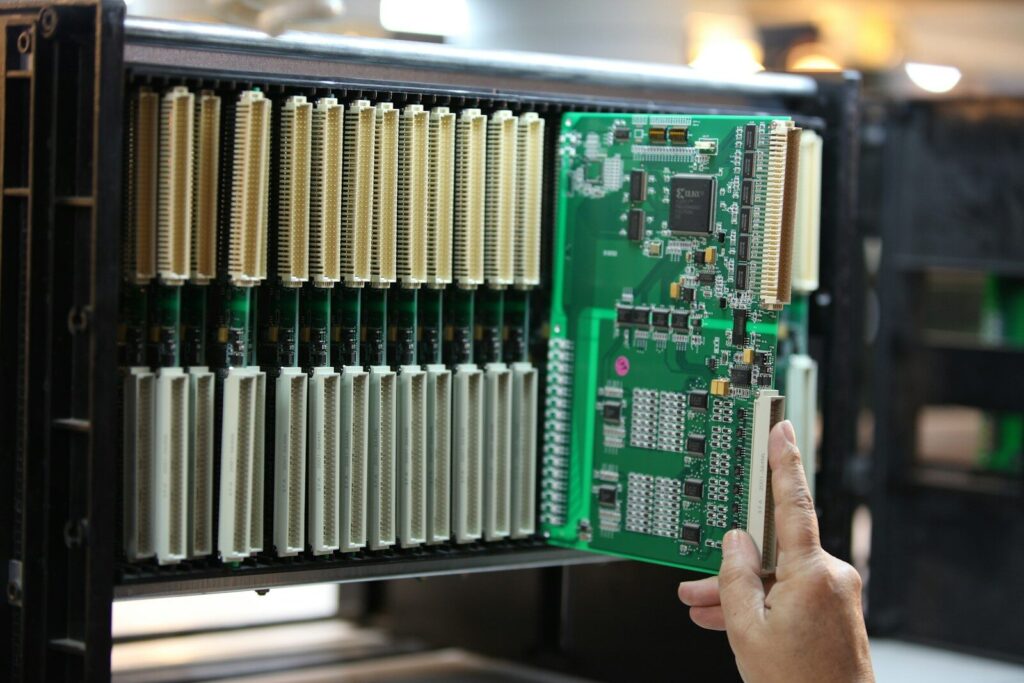
Server boards sit behind most of the workloads that matter now: cloud tenants, model training, storage arrays and the switches that connect them. A single rack can hold a dozen compute nodes, each with a board carrying two sockets and enough PCIe lanes to feed eight accelerators. When one board fails qualification, the delay doesn’t stay inside the fab. It moves into rack integration, then into a customer’s capacity plan. A high-speed PCB order deserves a longer checklist than a four-layer control board.
The short answer: verify four things before you talk about price. Confirm the fabricator can build the layer count, backdrill, and impedance control your stackup needs. Confirm the laminate class matches your loss budget. Confirm the test flow ends at IPC-6012 Class 3. Then check capacity and lead time, compare quotes line by line, and audit the process once before releasing volume.
Those checks run in that order, because a failure at the first makes the rest irrelevant.

What separates a server PCB from a standard board?
A server board differs in four measurable ways: layer count, board size and thickness, laminate loss class, and acceptance level. Connector count, redundancy and service life follow from those four.
| Parameter | Desktop board | Server board |
|---|---|---|
| Layer count | 4 to 8 | 16 to 24, sometimes beyond 30 |
| Finished thickness | 1.6 mm | 2.0 to 3.2 mm |
| Board size | ATX, 305 x 244 mm | E-ATX 12 x 13 in, EE-ATX, or custom blade and rack formats |
| Laminate | Standard FR-4 | Low-loss or ultra-low-loss |
| Via technology | Through-hole | Backdrilled through vias, blind and buried vias, microvias |
| Acceptance | IPC Class 2, sampled test | IPC-6012 Class 3, 100% electrical test |
| Service life | 3 to 5 years, intermittent load | 5 to 10 years, continuous load |
The table is a starting point, not a spec. Entry servers ship on 12 layers with mid-loss laminate. What doesn’t change is why each row exists: more copper, more lanes and more heat across a larger area, without losing signal or flatness.
How many layers does a server board carry, and how big is it?
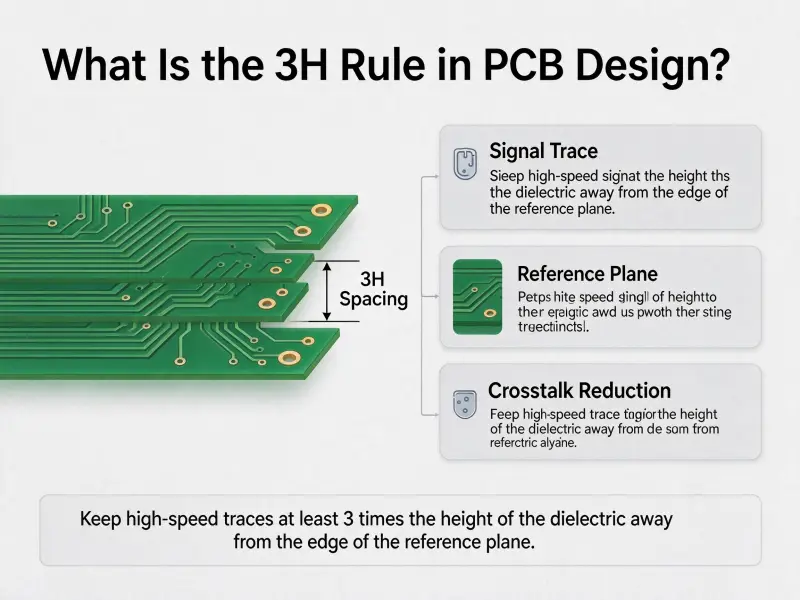
A dual-socket board with DDR5 and PCIe 5.0 typically lands between 16 and 24 layers. Escaping a socket with several thousand pins takes 8 to 10 signal layers alone. Holding power plane impedance under a milliohm at sub-1 V core voltage takes 4 to 6 dedicated power layers at 2 oz to 4 oz copper. Keeping crosstalk between 32 GT/s pairs and DDR5 buses low takes solid reference planes between signal layers. Accelerator baseboards and switch backplanes often run past 30.
Size creates a problem that’s easy to underestimate. A 2.4 mm board at 500 mm long has to stay flat through reflow at 260°C, because warpage across that span decides whether a 0.35 mm pitch package lands or bridges. Fabricators that build large backplanes show a flatness measurement rather than a promise.
Why does the laminate class decide the design?
Loss is a budget, and the budget gets spent before routing starts. PCIe 5.0 runs at 32 GT/s per lane, putting the Nyquist frequency at 16 GHz. The PCI-SIG base specification allows about 36 dB of total insertion loss across the channel at that frequency. Subtract roughly 9 dB for the CPU package, 9.5 dB for the add-in card and 1.5 dB for the connector, and around 16 dB is left for board routing, vias included.
| Laminate class | Df at 1 GHz | Loss at 14 to 16 GHz | Relative cost |
|---|---|---|---|
| Standard high-Tg FR-4 | 0.018 to 0.022 | about 2 dB/in | 1x |
| Mid-loss | 0.006 to 0.010 | 1.0 to 1.4 dB/in | 1.3x to 1.8x |
| Low-loss | 0.002 to 0.004 | 0.7 to 0.9 dB/in | 2.5x to 4x |
| Ultra-low-loss | 0.001 to 0.002 | 0.5 to 0.7 dB/in | 4x to 6x |
The ranges follow published laminate datasheets and stripline measurements on roughly 5 mil traces. Real numbers move with copper roughness and resin content, so a field-solver report on your stackup beats any table, including this one.
Standard FR-4 spends the board’s share of the budget in 6 or 7 inches. A riser that needs 15 inches of reach forces either a low-loss laminate or a retimer, and the retimer usually costs more than the laminate upgrade. That trade is the most common place a server program loses money in the wrong phase.
What does server grade mean in acceptance terms?
Server grade isn’t a marketing tier. It’s a set of documented limits. Boards are built to IPC-6012 Class 3, which tightens annular ring, copper-in-hole, and plating thickness beyond Class 2 and requires a 100% electrical test rather than sampling. In practice that means four-wire low-resistance testing sensitive enough to catch a barrel that’s thin but still conducting, plus impedance coupons per panel. Glass transition temperature usually sits at 170°C or above, so the board survives lead-free reflow without a cracked barrel.
Which fabrication capabilities should you verify first?
Verify the capability boundary in writing before you discuss price. A fabricator that can’t state a maximum layer count, a backdrill tolerance and an impedance tolerance in numbers can’t be compared with one that can.
| Capability | What to ask for | Why it decides the job |
|---|---|---|
| Layer count | Maximum build, and the highest count in production last year | A 32-layer quote with no 32-layer history is a prototype risk |
| Thickness and aspect ratio | Maximum finished thickness and aspect ratio | Deep backplanes need drilling control most shops lack |
| Line and space | Volume minimum, not the lab minimum | Sets whether 3 mil escape fits around a fine-pitch socket |
| Impedance | Differential and single-ended tolerance, coupon count | A ±8% claim needs a TDR report behind it |
| Backdrill | Depth tolerance and residual stub limit | Stub resonance closes a 16 GHz eye faster than dielectric loss |
A fabricator should take your stackup and return a build with Dk, Df, dielectric thickness and impedance targets per layer, then confirm it before tooling. Ask whether impedance is calculated from the actual laminate lot or copied from a template. The gap shows up as ±8% against ±12%, and ±12% can mean a link that passes on the bench and fails in a rack.
Every through-via on a high-speed pair leaves a stub. Above 14 GHz it behaves as a resonator and closes an eye the laminate just paid to open. Controlled-depth backdrilling removes it, with production tolerances around ±0.05 mm and a residual stub under 10 mil. Dense accelerator modules go the other way and use laser microvias or multi-order HDI to escape the package, which is where HDI PCB capability starts to matter on a server build.
How do you check quality control and test coverage?
Check the test sequence, not the certificate on the wall. A server flow runs design review, in-process inspection, 100% electrical test and lot documentation before shipment, and each step needs a named owner and a record you can see.
- DFM and stackup review against the fabrication notes, with open questions answered before tooling.
- Inner-layer AOI on every layer, including fine-line panels with dark solder mask.
- Impedance coupon measurement on the first panel and per lot, with TDR profiles kept.
- Backdrill depth verification by X-ray or cross-section, not by drill program.
- 100% four-wire low-resistance test, which catches thin barrels and near-opens that continuity testing passes.
- Final inspection against approved artwork, then moisture-barrier packing with lot traceability.
Ask for these with the first order: impedance report, backdrill cross-section, microsection data and a lot-level yield summary. A fabricator that supplies them unprompted is telling you something about the next order too.
Which standards and certifications actually matter here?
Four items carry real weight on server work: ISO 9001 for the quality system, UL recognition for flammability, IPC-6012 Class 3 for acceptability, and RoHS or REACH for material compliance. Aerospace and medical certificates are worth having but say little about a server program.
| Standard | Covers | Weight on a server program |
|---|---|---|
| ISO 9001 | Quality system, process control, traceability | Baseline requirement |
| UL recognition | Flammability rating of laminate and board | Required for most enterprise installations |
| IPC-6012 Class 3 | Acceptability limits for rigid boards | Directly defines what you accept |
| RoHS and REACH | Restricted substances | Required for EU-bound hardware |
Treat the list as a filter, not a score. A fab with ISO 9001, UL and a documented Class 3 flow will outbuild one with six certificates and no backdrill control.
What drives server PCB price, and how do you compare quotes?
Four variables explain almost all of the spread between server PCB quotes: layer count, laminate class, copper weight and test coverage. If two quotes differ by more than those four can explain, one of them is quoting a different board.
| Driver | Why it moves price | What to check |
|---|---|---|
| Layer count | Each lamination cycle and drill program adds cost | Layer count plus build sequence stated |
| Laminate class | Up to 6x on material alone at the extremes | Exact laminate named, with Dk and Df |
| Copper weight | Heavy copper means longer etch and harder lamination | Copper per layer, not one average |
| Test and inspection | Class 3 test and cross-sections consume capacity | Whether testing and reports are included |
Comparing quotes means forcing them onto one sheet: same stackup, laminate, copper, finish, test level and documentation. Separate tooling and NRE from unit price, and ask what the unit price does at the second and third order. A quote that’s cheap because it excludes impedance testing isn’t cheaper. It’s a different product.
How do you assess capacity, lead time, and supply risk?
Ask what the lead time includes, not what it is. Layer count, laminate stock, backdrill capacity and test queue each add weeks independently, and an honest answer names which one is binding.
The demand behind those queues isn’t speculative. The server PCB market was estimated at USD 56.28 billion in 2026 and is forecast to reach USD 94.60 billion by 2033, a 7.7% compound annual rate (Coherent Market Insights, base year 2025, published April 2026). Growth that size pulls on the same laminate and drilling capacity everyone else is booking.
- Is the laminate in stock at the specified grade and thickness, or does it need ordering?
- How many backdrill and sequential-lamination slots are open next month?
- How long is the Class 3 test queue at this layer count?
- If that laminate is unavailable, which approved equivalent sits on the shelf, and who signs off on the swap?
The last one matters more than buyers expect. A substitution changes Dk, a change in Dk moves impedance, and impedance held at ±8% has no room for a swap nobody modelled.
How should you run the audit and the first order?
Send a complete RFQ package, audit the process once, and qualify on a pilot lot before volume. Most server PCB failures trace to an incomplete data package or an assumption nobody wrote down, not to a machine that couldn’t hold tolerance.
The package needs Gerber data, the stackup with Dk and Df per layer, impedance targets, backdrill requirements, press-fit specifications, surface finish, panelization, and quantity by delivery. Add your acceptance class and the reports you expect with each lot. A fabricator working from Gerbers alone will quote something, but it won’t be your board.
See four things on the audit: how stackups get reviewed before tooling, how impedance coupons are logged, how backdrill depth is verified, and how a nonconformance gets closed. Sign an NDA before sending files, and confirm who owns tooling at the end of the program.
Then run a pilot. Ten to twenty boards at production settings says more about yield than any brochure. If the pilot ships with TDR data, cross-sections, and a yield summary without follow-up emails, the process is in control. Where fabrication and assembly sit under one roof, confirm that OEM PCB PCBA contract manufacturing covers both stages, because a split supply chain adds a handoff where stackup assumptions get lost.
FAQ
What is a server rack PCB, and is it built differently from a server motherboard?
A server rack PCB usually means a backplane or midplane that distributes power and signal between nodes, not the compute board itself. It’s longer and thinner, so flatness and panel support dominate. It carries press-fit connectors that demand tight hole tolerance and often backdrilling. Acceptance class stays the same; mechanical risk is higher.
How long does it take to go from a server PCB quote to a first article?
It depends on what the quote assumes. A quote built on laminate in stock, open drill capacity and a short test queue reaches first article far sooner than one built around an ordered laminate and a full queue. Ask each supplier to state its assumptions, then compare quotes on those assumptions instead of the total row.
What happens if the laminate in the stackup is out of stock?
The fabricator should propose an equivalent grade with published Dk and Df, and your signal integrity team should re-run the loss budget before anything gets drilled. Moving to a lower-loss grade costs money and keeps the design safe. Moving to a higher-loss grade quietly eats the routing budget and can turn a working channel into a retimer requirement.