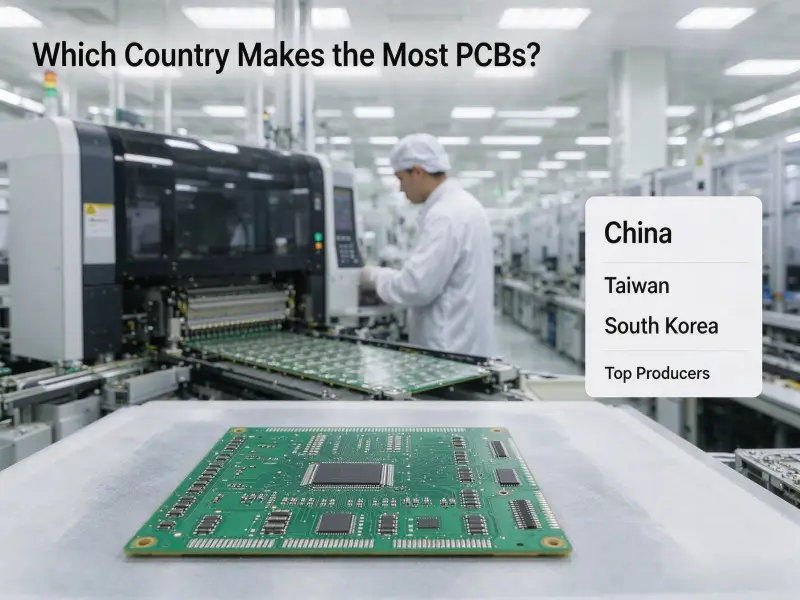
Printed circuit boards sit inside almost every electronic product, yet the quotes buyers receive for them can look surprisingly small. A rigid PCB built on two layers of standard laminate is often priced low enough that engineers treat it as a consumable instead of a component worth examining closely.
That reaction is understandable. The raw materials are commodity items, the production lines are highly automated, and the same designs are repeated thousands of times. But a low pcb price on a quotation does not explain why the number is low, and it says nothing about what happens after the purchase order. Buyers who treat the board as a fixed cost often find the real expense later, in testing, rework, and delay.
PCBs are cheap because standard boards are made from commodity materials on automated lines at high volume, with shared tooling and very little engineering work per board. The price falls when a design fits the defaults: common laminate, common copper weights, standard drill sizes, standard finishes, and panel layouts that use the sheet efficiently. It rises when the design asks for anything outside those defaults. Cheap describes a manufacturing condition, not a quality grade. The cheapest board is the one that fits the process so well that it builds correctly the first time.
The sections below show where the number comes from, where extra costs appear, and how to read a quotation before committing.
| What a buyer sees | What usually drives it | Where the number can move |
|---|---|---|
| Low unit price on a simple two-layer board | Commodity laminate, shared setup, efficient panel use | Layer count, copper weight, finish, hole density |
| Similar-looking quotes from different sources | Different assumptions about yield, testing, and acceptance | Inspection scope, rework responsibility, delivery terms |
| An inexpensive first prototype | Small batches on a standard stack-up | Scale-up, tolerance stack, changes after the first build |
| A large gap between prototype and production pricing | Setup and engineering effort spread over different quantities | Panel layout, tooling charges, revision stability |

What actually sets the price of a PCB?
A PCB price is the sum of material, machine time, engineering time, and yield risk. Layer count, laminate type, copper weight, finished hole sizes, surface finish, and panel utilization set the base number. Quantity and delivery schedule change it further. None of these factors is a quality grade on its own; they are inputs. A board is cheap when its design matches a supplier’s standard process and expensive when it does not.
A quotation compresses a long chain of decisions into one figure. Each decision either keeps the board inside a routine production flow or pushes it toward custom handling. Understanding the mechanism matters more than memorizing a price, because the same design can be quoted very differently once the assumptions behind it change. Two boards that look alike on a workbench may have taken very different routes through imaging, drilling, plating, and final inspection.
Material and stack-up choices
Standard FR4 laminate and common copper foils are traded in large volumes, so their cost per panel is predictable. A board that uses one of these familiar stack-ups needs no special qualification, no unusual press cycle, and no separate material handling. Move to a laminate with a higher glass transition temperature, a metal core, or a specialized dielectric, and both the material bill and the process controls change. The board itself may look identical from the outside, but the factory now has to manage a different set of tolerances.
Copper weight matters in the same way: heavier foil uses more material and takes longer to process, while a standard weight keeps the board inside a known process window. Surface finish is another choice with a direct cost effect. Common finishes such as HASL, ENIG, and OSP each use different chemistry and equipment, and each suits a different assembly or storage requirement. Choosing the cheapest finish for a board that will sit in storage or go through several reflow cycles can create problems that cost far more than the finish saved.
Volume, panel utilization, and automation
Most boards are not made one at a time. Several copies are nested into a larger panel, processed together, and separated at the end. A layout that fills the panel well spreads setup and material waste across more usable boards, which lowers the unit cost without changing the design. A layout that leaves large empty areas pays for material that never becomes a product. Panel rails, tooling holes, and the spacing between boards all affect how many good boards come off a sheet.
Automation carries much of the routine work: imaging, drilling, plating, solder mask application, and inspection repeat the same steps for every panel. In PCB manufacturing, the expensive part is usually the exception, not the routine. A supplier running the same stack-up every day can keep materials in stock, tooling on the shelf, and operators trained on one repeatable flow. None of that removes the need for care, but it removes the cost of starting from scratch.
Design complexity and tolerances
Fine lines, small drill diameters, high aspect ratios, tight impedance control, and blind or buried vias all demand tighter process control and more inspection. Each of these features is legitimate, but each one also reduces the margin for error. A wide trace with a generous annular ring tolerates normal process variation; a fine trace with a narrow ring does not. The second board can still be made, but it needs better imaging, cleaner drilling, and more inspection to reach the same yield.
Requirements are normally documented against industry standards: the IPC publishes widely used design and acceptance documents for printed boards. When a buyer specifies a stricter acceptance level, the inspection and process controls behind the number change, and so does the price. A PCB circuit that stays inside common rules costs less to build repeatably. This is why a design review before production often saves more than a price negotiation.
How much do PCBs usually cost?
There is no single answer, because a PCB price is calculated from a specific design, a specific quantity, and a specific delivery schedule. Two buyers can ask the same question and receive very different quotes. The useful question is not the average price of a board, but which variables in the quote are driving the number. Once those variables are visible, quotes become comparable.
| Quote variable | Typical effect on price | Reason |
|---|---|---|
| Layer count | Rises as layers are added | More laminate, imaging, and lamination steps |
| Copper weight | Rises with heavier copper | More foil and longer processing |
| Laminate type | Specialty materials cost more | Different material price and process controls |
| Minimum hole size and aspect ratio | Tighter limits raise cost | More precise drilling and higher defect risk |
| Surface finish | Varies by finish selected | Different chemistry, equipment, and handling |
| Board outline and panel fit | Poor nesting raises unit cost | More panel area paid for per usable board |
| Quantity per production run | Higher volume lowers unit cost | Setup is spread across more boards |
| Delivery time | Shorter lead time raises cost | Line priority and expedited handling |
| Test coverage | More testing raises cost | Added fixtures and machine time |
| Engineering changes | Late revisions raise costs | Rework of tooling and documentation |
Anyone beginning PCB learning meets the same problem: published price examples rarely match a real project because they assume a generic board in a generic quantity. A PCB price becomes meaningful only when the buyer supplies Gerber files, the stack-up, the required quantity, and the delivery date. Without those inputs, any figure is a placeholder. Treat a rough number as a screening tool, not as a budget commitment. The variables in the table also interact. A tighter hole requirement matters more on a thick board than on a thin one; a short delivery window matters more on a specialty laminate than on a stock material. Reading a quote means looking at the combination, not at each line in isolation.
Why standard boards are so cheap
Standard boards are cheap because nothing in them is unusual. They use widely available laminate and copper foil, standard drill and routing tools, and finish the line already runs every day. Setup is shared across many customers, panels are nested to reduce waste, and inspection follows routine criteria. The saving comes from repeatability, not from lower quality.
The economics are straightforward. A factory that runs the same material and the same process every day can buy materials in bulk, keep tooling on the shelf, and train operators on one repeatable flow. There is no engineering campaign before production and no learning curve during it. Material suppliers hold stock for these stack-ups, so lead time is shorter and the risk of a material substitution is lower. Inspection criteria are familiar to everyone involved, which reduces the arguments that slow a project down.
In PCB electronics, the bare board is often a small share of the finished assembly cost, which is why buyers rarely question it until something goes wrong. The low unit cost is real; it is simply a narrow view of what the project will spend. A pcb price that looks attractive on a spreadsheet is only the first line of a longer account. That does not make standard boards second class. It makes them the right choice for a large share of products, provided the design stays within what the process can hold.

The hidden costs behind a low unit price
The unit price covers the board. It does not cover failed boards, manual rework, extra inspection, engineering time spent chasing a problem, or the delay while a design is adjusted. Those costs are paid after the purchase order, often from a different budget. A board that saves a little on paper can cost more by the time the product ships.
These costs are predictable in kind even when their size is project-specific. They appear when the design leaves the supplier’s standard process, and they tend to arrive together rather than one at a time.
Yield, rework, and scrap
Every failed board has already consumed its share of material, machine time, and handling. Inspection adds more time, and a board that can be recovered goes through manual rework before it is counted as usable. Boards that cannot be recovered are scrapped and must be replaced, which extends the schedule. A design that pushes tolerances may still produce acceptable boards, but the variation itself becomes a cost that never appears on the original quotation.
Over a long run, that variation matters more than a small difference in unit price. The effect compounds when the board sits late in an assembly flow: a failure found after components are placed costs more to resolve than one found at bare board inspection. This is one reason test coverage should be discussed before ordering rather than after the first bad batch arrives.
Lead time, logistics, and engineering time
A slow or uncertain delivery schedule keeps a project waiting and ties up working capital. Shipping, import handling, and receiving inspection add both cost and elapsed time when the supplier is far away. Engineering time is the least visible item: someone has to diagnose failures, adjust the design, and communicate with the supplier until the problem closes. That work is real, but it is rarely charged back to the board. When comparing options, count the time as carefully as the money. A supplier that asks design questions early can look slower during quoting and still deliver a steadier run. A supplier that accepts anything quietly may ship on time and still leave the engineering team with weeks of cleanup.
When a cheaper board stops being cheap
A low price is a good deal only while the design fits a standard process. Once a product needs denser interconnects, a metal core for heat, controlled impedance, or a bendable section, the standard cost model breaks down. At that point the cheapest-looking quotation may be the one that cannot actually build the board reliably.
An HDI PCB uses finer lines, smaller vias, and more lamination cycles than a conventional board. Each of those steps adds process control and inspection, and each one is necessary for the design to work. A metal core board solves a thermal problem but changes drilling, plating, and handling. A high frequency design needs a dielectric with tightly controlled electrical properties, and the material alone narrows the field of suppliers. A rigid-flex board adds a bending region that must survive assembly and use, so the stack-up and the cover layers become part of the mechanical design rather than a detail.
Ceramic boards serve another set of thermal and reliability needs and follow yet another process route. None of these boards is expensive by accident. The cost reflects steps that cannot be skipped. A PCB board design that ignores those requirements may be cheap to fabricate and expensive to field, because failures move from the factory to the customer. This is where the question of why boards are cheap becomes the wrong question. The right question is whether the low price matches what the product actually needs and whether the supplier has demonstrated the process before.
How to compare PCB quotes beyond unit price
Compare the assumptions behind the quotes, not just the final figure. Ask what yield level is assumed, which tests are included, what happens to boards that fail, how delivery time is set, and who pays for rework. Two quotes with the same number can carry very different obligations.
A practical comparison follows the same order every time:
- Confirm that every supplier is quoting the same Gerber files, stack-up, and revision.
- Ask which acceptance standard applies and how it is verified.
- Check what test coverage is included and what is charged separately.
- Clarify the replacement or rework policy for boards that fail inspection.
- Separate one-time tooling and engineering charges from recurring unit cost.
- Confirm which material and finish are assumed, in case a substitution is planned.
- Compare delivery terms, packaging, and shipping responsibilities.
- Ask how design questions are handled and who signs off on changes.
This is the part of the PCB board design that pays for itself. A short review before ordering prevents most of the surprises described above, and it gives the buyer a basis for comparing quotes that look identical on the surface. Total cost of ownership is not a complicated formula; it is the unit price plus every cost that follows the purchase order. The same logic applies when you source PCB assembly with the bare boards: check the inspection record and the change control process, since a cheap assembly quote can undo a well-chosen board.
Frequently asked questions
Does a lower PCB price always mean lower quality?
No. A low price can simply reflect a design that fits a standard process well. Verify it by asking for cross-section reports, test records, and a sample build before placing a large order. Traceability and a clear acceptance standard tell you more about quality than the number on the quote.
Can changing laminate reduce cost without redesigning the whole board?
Sometimes, but only if the electrical, thermal, and reliability requirements still hold. A material substitution can change impedance, expansion behavior, and solder performance. Ask the supplier to confirm equivalence in writing and to flag any process change before approving it.
How should a first prototype order be priced against a production run?
Prototypes carry setup and engineering effort that a production run spreads across many boards, so comparing price per board alone is misleading. Ask for one-time charges as a separate line and compare cost per panel instead. Also ask how many revisions are included before tooling is re-cut, since early design changes are the most common source of unexpected prototype cost.