Open almost any electronic device, and the board inside is the same shade of green. It does not matter whether the board came from a prototype order or a control cabinet that has run for a decade. It has nothing to do with what PCB boards are made of underneath. The question “Why is PCB green?” has an answer that is part engineering, part economics, and a small part habit.
The green on a printed circuit board is solder mask, a thin pigmented polymer layer coated over the copper traces. The panel underneath is a pale yellow to amber fiberglass composite, and the copper is reddish-brown, so the color you see belongs entirely to that top coating. Green mask was the first type that could be applied photographically, which is why it spread first, and it survived because it gives the best contrast for inspection, the widest process window on the line, and the lowest material cost of any color available.
The sections below cover what the mask does, how green became the standard, and where color still matters when you buy boards.
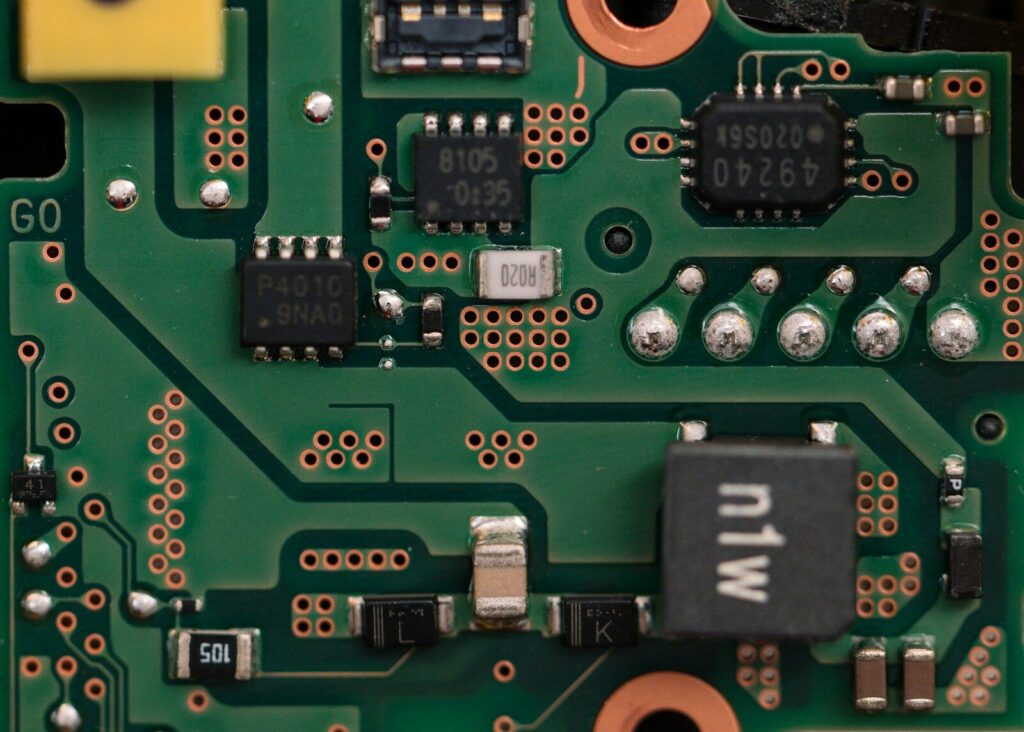
The green comes from the solder mask, not the board.
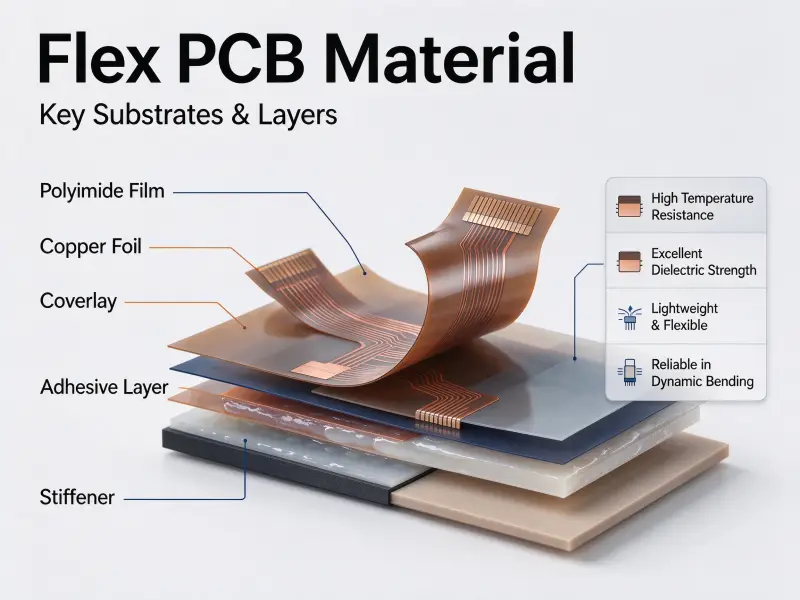
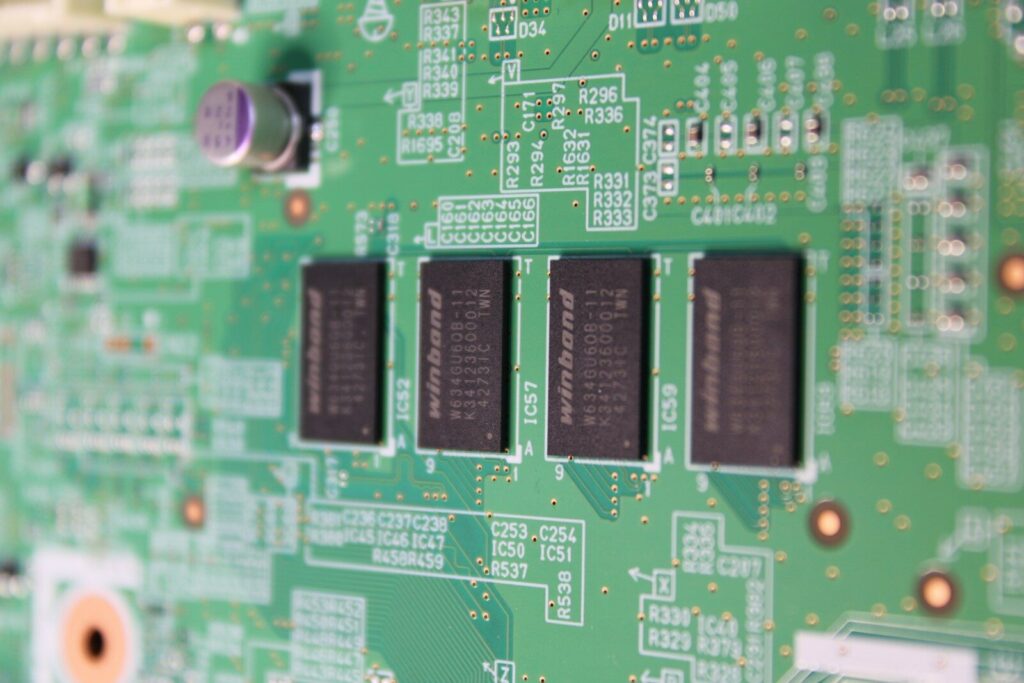
A board looks green because of its outermost layer, not its body. FR4, the glass-fiber and epoxy laminate that gives a board its stiffness, cures to a translucent yellow when thin and a deeper amber when thick. Copper foil is reddish-brown. Solder mask is the green layer, and it covers everything except the pads and contact areas that have to be soldered.
Ask why the printed circuit boards are green, and the answer starts at the surface. The mask is applied as a liquid photoimageable ink across the whole panel, then selected areas are exposed to ultraviolet light so the polymer hardens and stays.
- The panel is cleaned and coated with ink on both sides.
- A film or laser exposes the areas that keep their coating, and UV light cross-links the polymer.
- A developer washes away unexposed ink, opening the pads, vias, and test points.
- The panel is cured, which sets hardness, adhesion, and color.
The mask is not cosmetic. It keeps copper from oxidizing, stops solder from bridging between closely spaced pads, and shields the surface from moisture, contamination, and handling wear.
Mask material is qualified rather than chosen by eye. The industry standard for permanent solder mask, IPC-SM-840, sets minimum requirements for adhesion, hardness, chemical resistance, and surface insulation resistance, so a color reaches production only after passing those tests. Under a green mask, copper reads as brighter lines, and a copper pour becomes a large pale area, which makes scratches and thin spots easy to catch. Searches phrased as “why PCB color is green,” using the British spelling, describe the same layer.
| Layer | Material | Natural color | Job |
| Solder mask | Pigmented epoxy or acrylate | The color you see | Insulates traces, blocks solder bridges, protects copper |
| Silkscreen | Epoxy ink | White by default | Component references and labels |
| Copper | Electrodeposited or rolled foil | Reddish-brown | Carries signals and current |
| Laminate | Glass fiber and epoxy (FR4) | Yellow to amber | Mechanical support, insulation, dielectric |
How green became the industry default
The first practical solder mask was green, and for a period there was no alternative. Manufacturers standardized on it and wrote their inspection routines around it, and by the time other colors reached the market, green was already the reference point the whole supply chain measured against.
The first answer to why PCBs were green is chemical. The earliest mask systems were resin formulations whose cured color was already dark green, and when pigment was added to make the coating visible on the line, green was the version available in volume.
The second push came from the buyers with the most leverage. Through the 1950s and 1960s, the largest customers for high-reliability boards were military and aerospace programs, and the suppliers serving them built their lines around one mask color. Their procurement specifications set performance and qualification requirements for rigid printed wiring boards, defining materials and acceptance criteria rather than a required color. The green default came from procurement habit and the supplier base behind it, which is why the green circuit board is still the safe answer for high-reliability work.
Why the first color won
Once an industry builds its tooling around one color, switching costs money in places that are easy to overlook. Exposure recipes are tuned for one pigment load, inspection algorithms and reference images come from one color, and repair documentation assumes the same background. Changing the color does not just change appearance; it invalidates a measurement baseline built over decades.
Why green still wins in production
Green survives on the factory floor rather than in a chemistry lab. Camera-based inspection, the human eye, and the exposure window all favor it, and none of those three care what color the industry was using in 1965.
Why are most circuit boards green today, when a different mask reaches the market every few years? Because the equipment that checks them was calibrated around green and never needed to change. Anyone asking why PCB is always green should note the exceptions: LED boards usually run white, and consumer products often run black. Green simply holds the default position every other color is measured against.
AOI systems are calibrated for green.
Automated optical inspection compares production panels against a reference image using cameras and controlled lighting. Mask, copper, silkscreen, and pad surfaces all have to be distinguishable, and on a green board the differences are pronounced. Dark masks cut the contrast between copper and coating, so inspection recipes need to be rebuilt. For a buyer comparing suppliers, the question worth asking during custom PCB manufacturing is whether the line already has inspection recipes for the color you specified or whether your order will be the first one to test them.
Manual inspection and the human eye
Human photopic vision peaks around 555 nanometers, in the yellow-green band, which means green surfaces are the easiest to hold in view for hours. On a green board, scratches, contamination, and poorly wetted joints stand out against a uniform background. On black they do not, and the technician works harder to see the same faults.
Exposure window and yield
Liquid photoimageable masks cure under UV light, and darker pigments absorb more of it. Black and white masks need the highest exposure energy, which narrows the window between under-cured ink and over-exposed features. Green sits at the comfortable end of that range, so minor drift in exposure or lamp age does not immediately produce scrap, and the headroom supports tighter tolerances on fine-pitch work.
| Mask color | Pigment load | Exposure demand | Trace visibility for inspection |
| Green | Low | Wide window | Best |
| Blue | Medium | Moderate | Good |
| Red | Medium | Moderate | Good |
| Black | High | High | Poor |
| White | High | Highest | Poor, needs black silkscreen |
Why green is usually the cheapest option
Green solder mask is made in a far larger volume than any other color, and volume sets the price. Fabricators buy it in bulk, run it on lines that are already set up for it, and rarely have to clean and requalify a line to switch. Non-standard colors, matte finishes, and custom matches usually bring a surcharge, a longer lead time, or a higher minimum order quantity instead.
The economics sit in the supply chain rather than in the ink. Global mask production is dominated by green, so it carries the lowest unit cost and the shortest lead time, which is why PCB price lists for standard colors look almost flat. In mass production the gap shows up in scheduling and inspection yield rather than in unit price.
Which colors cost the most?
Custom-matched colors and purple sit at the top of the range, because they are produced in small batches with inks ordered for a single job. Black, white, and matte finishes come next: black and white reduce inspection contrast and require higher exposure energy, and matte formulations add a process step. Blue and red usually land close to green. The pattern comes down to production volume and process adjustment rather than the cost of the pigment.
| Color | Cost position | Main reason |
| Green | Lowest | Largest production volume, no line change |
| Blue, red | Near green | Standard stock at most fabricators |
| Black | Higher | Lower inspection contrast, AOI recalibration |
| White | Higher | Highest exposure energy, LED-driven demand |
| Matte finishes | Higher | Extra process step, harder cleaning |
| Purple, custom match | Highest | Small batch, ink ordered per job |
Can PCBs be any color?
Almost any color can be produced within the limits of ink availability and process control. Green, blue, red, black, white, and yellow are routine, and matte and custom-matched masks exist as well. The real constraint is rarely the chemistry; it is minimum order quantity, lead time, and how much inspection difficulty the color adds.
Color choice in PCB electronics tracks application rather than preference. A white mask reflects light, which is why LED boards use it. Black reads as premium on consumer products and hides the routing. Blue and red show up on development boards, and yellow on industrial equipment where it stands out. None of these choices change how the circuit works.
| Color | Common use | Trade-off |
| Green | General electronics, industrial, high-volume production | None for most applications |
| Blue | Industrial and development boards | Slightly darker, still AOI-friendly |
| Red | Development boards, product differentiation | Similar to blue |
| Black | Consumer electronics, premium enclosures | Hides traces, harder inspection |
| White | LED lighting, diffusers | Needs black silkscreen, poor contrast |
| Yellow | Industrial and safety equipment | Limited availability, limited AOI support |
What limits your color choice?
Three things usually decide whether a color is practical. Minimum order quantity comes first, since custom ink may only make sense at volume. Lead time comes next, because a color the line does not normally run has to be scheduled around other jobs. Inspection comes third, because a color that reduces contrast shows up as yield variation rather than as a line item. Anyone in early PCB learning should take away one point: mask color is a manufacturing variable, not something you can treat as free.
Does PCB color affect performance?
No. Solder mask color does not change the dielectric constant, impedance, conductivity, or signal behavior of a board. Two boards with identical stack-ups and identical layouts perform the same whether the mask is green or black. Color changes how a board is inspected, how it behaves under heat, and how it looks, not how it works.
The confusion comes from mixing appearance with engineering. The layer that carries current is copper, whose geometry was fixed during layout. Indirect effects exist, and they are thermal and optical rather than electrical. Black mask absorbs more heat during reflow, so the profile may need a small adjustment on dense assemblies. A white mask reflects light back out of an LED package, and a dark mask hides routing.
What actually determines performance
If color does not matter, the decisions that do are the ones made during layout and stack-up:
- Laminate selection, since dielectric constant and loss tangent set how signals behave at frequency
- Stack-up and layer count, which control reference planes and routing density
- Copper weight and trace geometry, which set current capacity and resistance
- Controlled impedance on high-speed nets, which depends on dielectric thickness and trace width
Those choices belong to pcb board design. A green board with a poor stack-up will always underperform a black board with a good one: color is the surface, and the pcb circuit underneath is what the product depends on.
Frequently asked questions
Why are gaming and consumer electronics boards often black?
A black mask hides the routing, which suits products where the board is visible and a brand wants a distinct look. The cost is inspection. Black reduces the contrast AOI systems rely on and makes traces nearly impossible to follow by eye, so rework takes longer.
Do aerospace and medical boards have to be green?
No standard requires it, but green remains the common choice in those sectors. High-reliability work leans on visual and microscope inspection, and green gives the most stable background for spotting cracks, voids, and contamination. The preference is practical rather than regulatory.
Can a solder mask be matched to a specific color reference?
Manufacturers can match a target color, but the process is not like mixing paint. A custom match means ordering ink for the job, confirming color on a sample before production, accepting a higher minimum order quantity, and allowing extra lead time. It also moves the board off the standard inspection calibration.